
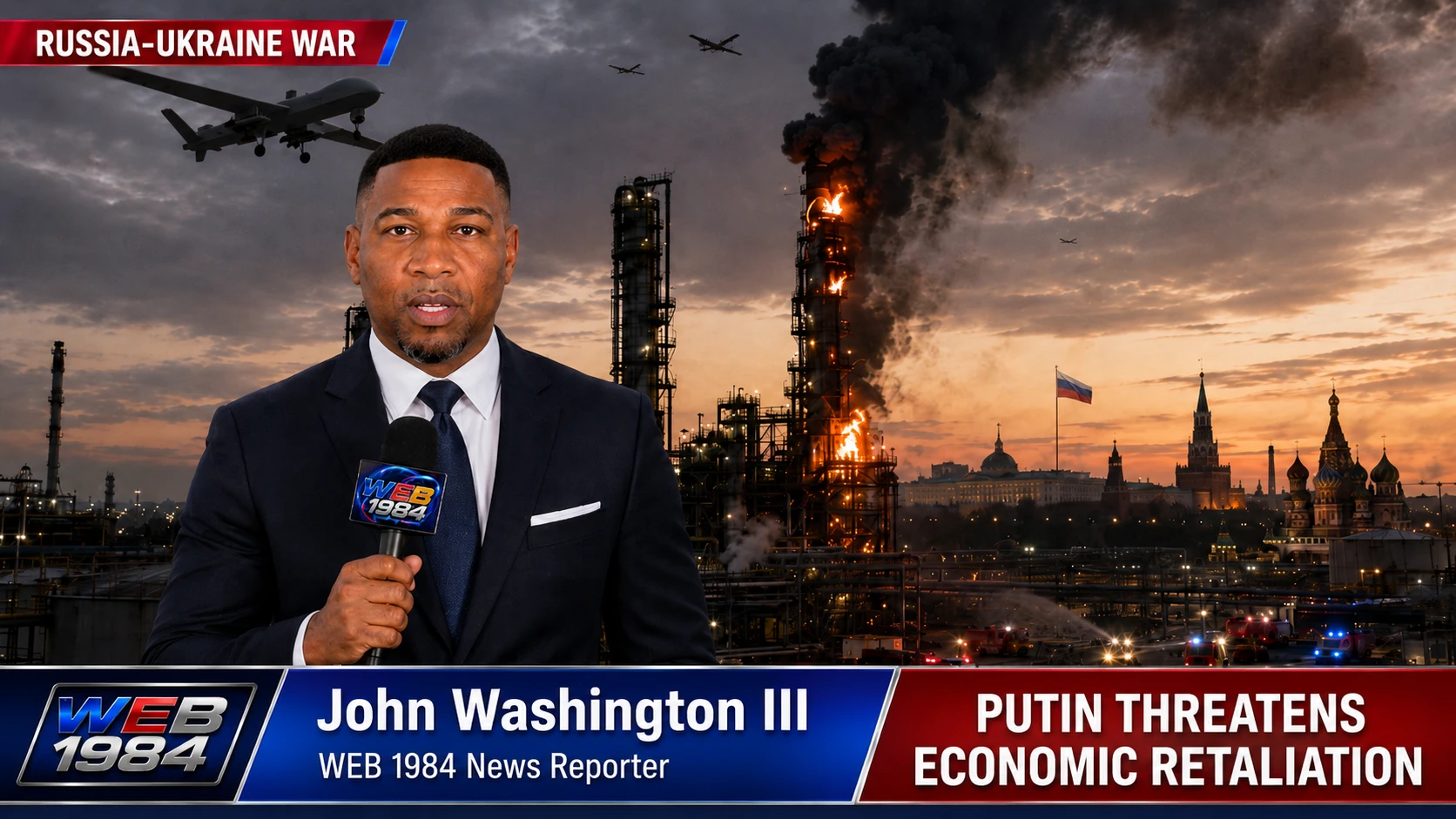
Putin Threatens Economic Retaliation as Ukraine Expands Deep-Strike Drone Campaign Inside Russia
By John Washington III — WEB 1984 News August 22, 2026 | 6:58 PM CT | www.web1984.com
MOSCOW/KYIV — Russian President Vladimir Putin issued a new warning to Ukraine on Saturday, saying Kyiv has opened what he described as a “Pandora’s box” by intensifying attacks on Russian economic infrastructure and promising that Moscow will respond by striking sectors of Ukraine’s economy that Russia considers particularly vulnerable.
Putin’s comments come as the war between Russia and Ukraine enters another increasingly dangerous phase, with both countries using long-range drones and missiles to attack infrastructure hundreds of miles away from the main battlefield.
Ukraine has significantly expanded attacks inside Russia this summer, targeting oil refineries, logistics centers, warehouses and other facilities that Kyiv says contribute to Russia’s ability to finance and sustain its war. Russia, meanwhile, has continued large-scale attacks against Ukrainian cities, infrastructure, industrial facilities and Black Sea export routes.
Putin Warns of a Wider Russian Response
Speaking to a Russian state television journalist, Putin accused Ukraine of deliberately attempting to damage the Russian economy and suggested that Moscow would now respond against Ukraine’s economic interests.
Putin said Kyiv had “opened Pandora’s box” and warned Ukraine to expect Russian attacks against its “most sensitive economic sectors.”
The statement is significant because it publicly frames Russia’s future strikes not simply as attacks against Ukrainian military facilities, but potentially as retaliation designed specifically to inflict economic damage.
Russia has already targeted Ukraine’s Black Sea infrastructure and facilities connected to the country’s agricultural exports.
Agriculture remains one of Ukraine’s most important industries, and Black Sea shipping routes are crucial for moving Ukrainian grain and other agricultural products onto international markets.
Ukraine Takes the Economic War Deeper Into Russia
Ukraine has increasingly relied on domestically produced long-range drones to hit targets far beyond the front lines.
Oil refineries have been a major focus. Kyiv says Russian energy infrastructure provides revenue and fuel that ultimately help sustain Moscow’s military operations.
But Ukraine’s campaign has expanded beyond oil facilities.
Warehouses and logistics sites connected to major Russian retailers have also been hit. During recent weeks, facilities connected to Russian online retailer Wildberries were repeatedly targeted, while an Ozon logistics facility was struck in the latest series of attacks.
Earlier this week, Reuters reported that gasoline shortages linked in part to refinery attacks had become serious enough that some fuel stations in Moscow were limiting how much gasoline motorists could purchase. Russia has also taken measures including fuel-export restrictions and petroleum imports in an effort to stabilize domestic supplies.
That gives Ukraine’s strategy a broader purpose than simply destroying individual buildings. Kyiv appears to be attempting to raise the economic cost of continuing the war by disrupting fuel production, transportation, supply chains and commercial operations inside Russia.
Deadly Drone Attacks Reported Across Russia
The latest attacks have also resulted in reported civilian casualties.
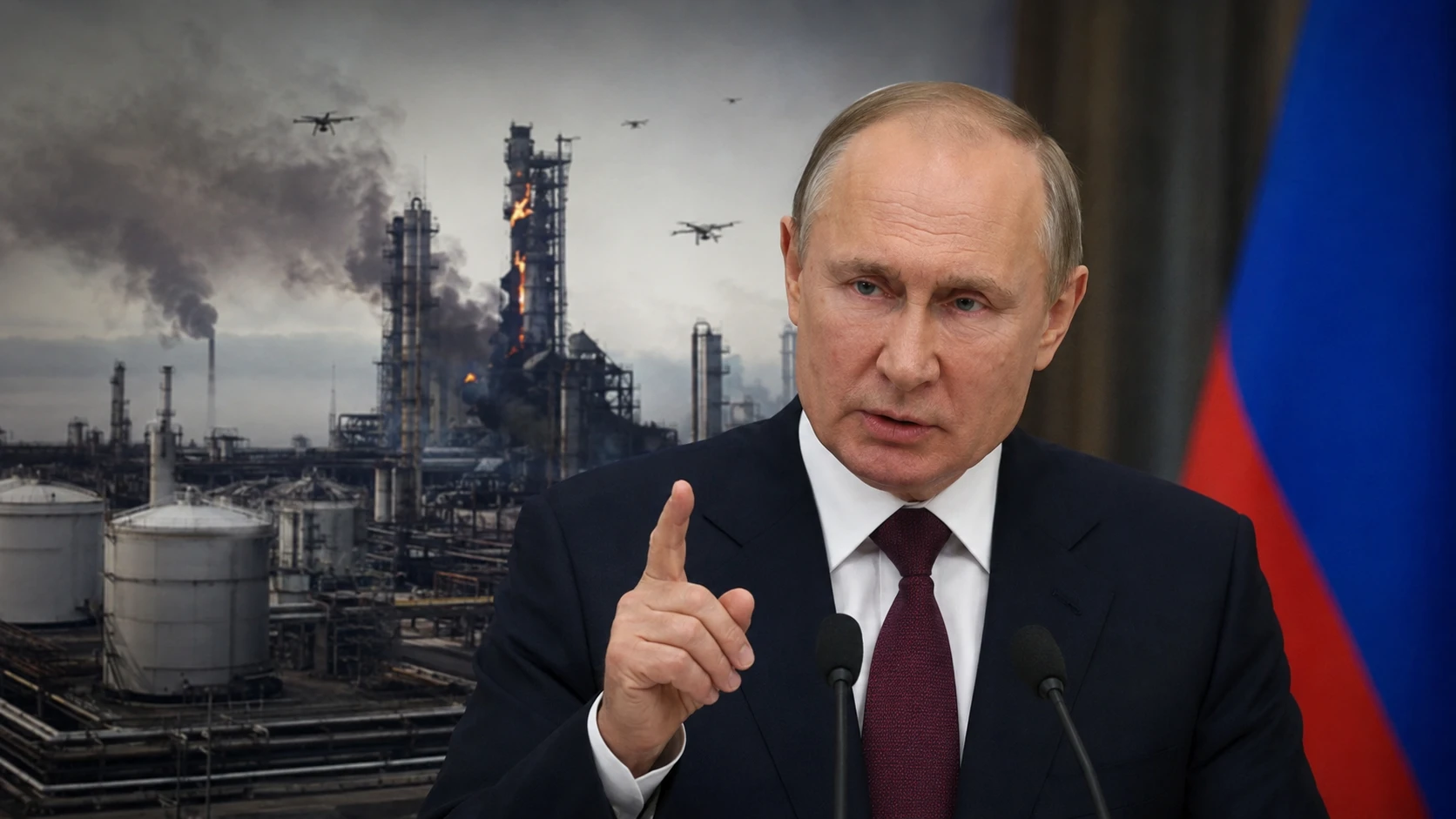
Russian and Moscow-installed officials said Ukrainian drones killed at least 10 people on Saturday across Russia and Russian-controlled areas of Ukraine.
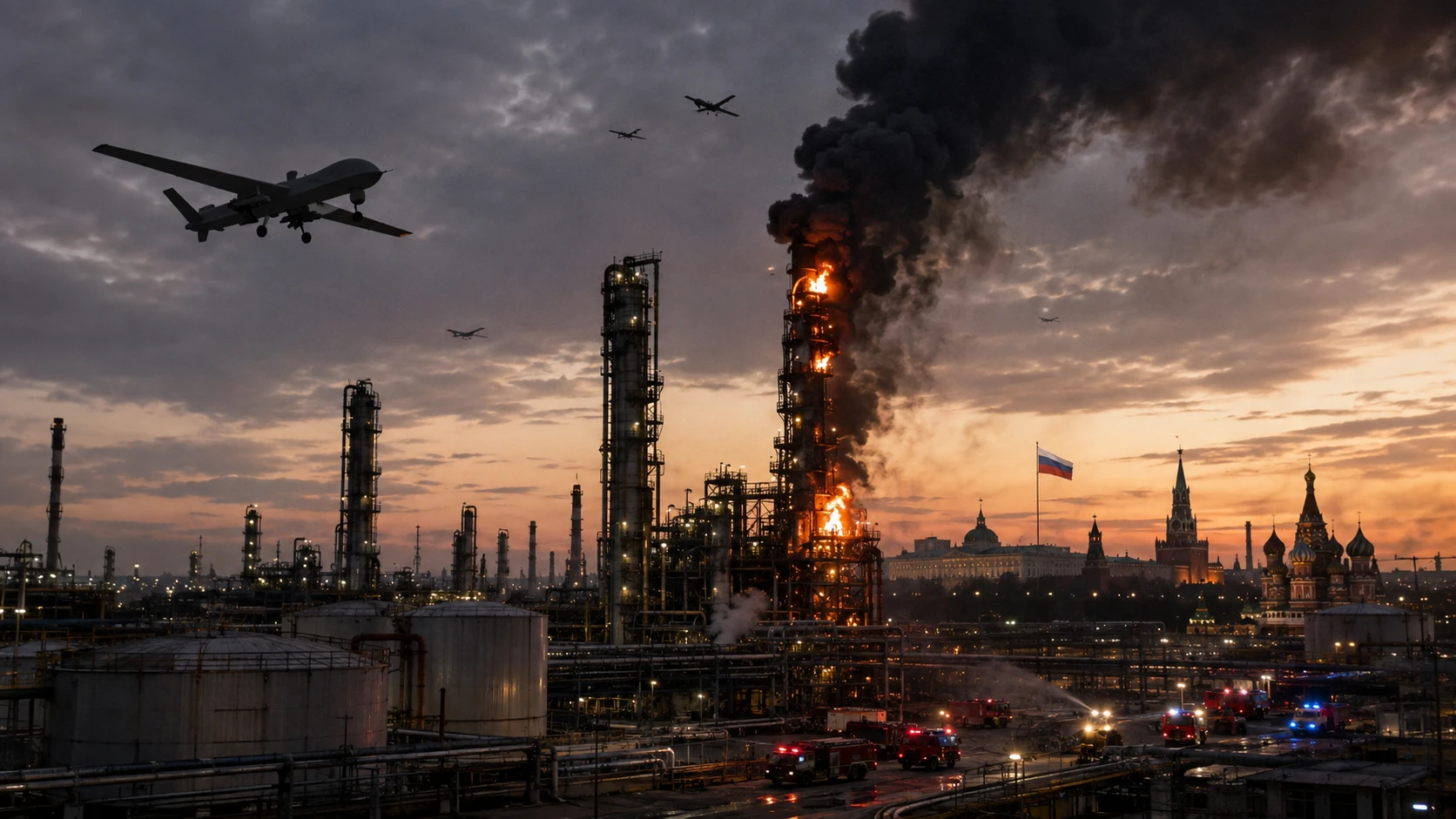
In Russia’s Samara region, regional officials said an elderly woman was killed during an attack that damaged industrial facilities. Ukraine’s military said it had struck the Novokuibyshevsk oil refinery and caused a fire.
Ozon said operations at one of its logistics centers in the region were suspended after a strike caused injuries.
Russian officials also reported deaths and injuries in the Krasnodar and Belgorod regions, as well as casualties in Russian-held Crimea and Luhansk. Russia’s Defense Ministry claimed its forces intercepted 457 Ukrainian drones overnight. Those battlefield and interception figures have not been independently verified.
The casualties demonstrate one of the growing dangers of the expanding long-range drone war: as attacks move deeper into heavily populated areas and increasingly target economic facilities near civilian communities, the possibility of civilian deaths rises.
Russia Continues Deadly Attacks on Ukraine
Ukraine, however, is carrying out its deep-strike campaign while facing continued Russian bombardment of its own territory.
On Friday, Ukrainian authorities said Russian drones struck a shopping center in Kryvyi Rih, killing at least 16 people and wounding more than 130.
Ukrainian President Volodymyr Zelenskyy accused Russia of carrying out a deliberate second strike approximately 30 minutes after the initial attack as emergency workers responded.
Ukraine said 22 children were among those wounded.
Russian attacks elsewhere in Ukraine have also caused civilian casualties in recent days, as Moscow continues an extensive missile-and-drone campaign against Ukrainian targets.
The competing attacks illustrate how the conflict is increasingly being fought simultaneously on two levels: conventional combat along the front and a long-range campaign aimed at undermining the opposing country’s economy, infrastructure and ability to continue fighting.
Black Sea and Global Grain Supplies at Risk
One of the most important areas affected by the escalation is the Black Sea.
Russia and Ukraine are both major agricultural exporters, making disruptions to Black Sea shipping potentially significant for countries that depend heavily on grain imports.
Putin argued Saturday that Russian agricultural production could compensate for disruptions to Ukrainian grain shipments and said he did not expect the escalating attacks to create a global shortage.
Russia itself has also experienced difficulties moving agricultural exports as Ukraine has targeted Russian port and shipping infrastructure.
Earlier this summer, Ukrainian attacks led Russia to temporarily halt shipping through the Don-Azov Channel, a strategically important route used for Russian grain exports. Reuters reported that as much as one-quarter of Russia’s wheat exports can pass through the affected area.
Concerns about Black Sea shipping have already contributed to volatility in international grain markets.
Russia and Ukraine previously participated in the Black Sea Grain Initiative, negotiated with the involvement of Turkey and the United Nations. The agreement allowed agricultural exports to continue moving through the Black Sea despite the war.
Russia withdrew from the agreement in July 2023.
Recent Turkish efforts to encourage restrictions on attacks against Black Sea commercial shipping have not yet produced a new agreement. Russia rejected the idea of a limited Black Sea ceasefire earlier this month, while Reuters reported that Ukraine had transmitted a proposal through a third party for both countries to stop attacks against civilian targets in the region.
Economic Pressure Is Becoming a Weapon
The latest escalation shows that economic infrastructure has become a central battlefield in the war.
For Ukraine, damaging refineries, fuel networks, warehouses and logistics operations offers a way to pressure Russia without having to seize Russian territory.
For Moscow, attacking Ukrainian ports, grain facilities, industrial sites and other infrastructure can weaken Ukraine’s economy while potentially reducing the financial resources available to Kyiv.
But that strategy carries substantial risks for civilians and international markets.
Oil facilities can be located near populated areas. Commercial warehouses employ civilians. Ports serve both military and civilian economic functions. Grain infrastructure connects the war directly to international food supplies.
As the list of targets expands, distinguishing between military-supporting infrastructure and ordinary civilian economic activity may become increasingly difficult.
Peace Talks Remain Distant
Despite threatening further retaliation, Putin again said Russia remains willing to discuss ending the war.
However, he insisted negotiations must be based on what Moscow calls the current “realities on the ground,” language generally understood to mean Russia expects any negotiations to reflect its territorial gains.
Putin dismissed other proposals communicated by Ukraine through intermediaries as unrealistic.
Ukraine has repeatedly maintained that Russia should not be rewarded for territory seized by force and has pushed for stronger security guarantees and continued international pressure on Moscow.
Those fundamentally different positions continue to make a comprehensive political settlement difficult.
A Dangerous New Phase
The immediate question is how far Russia will go in carrying out Putin’s threat.
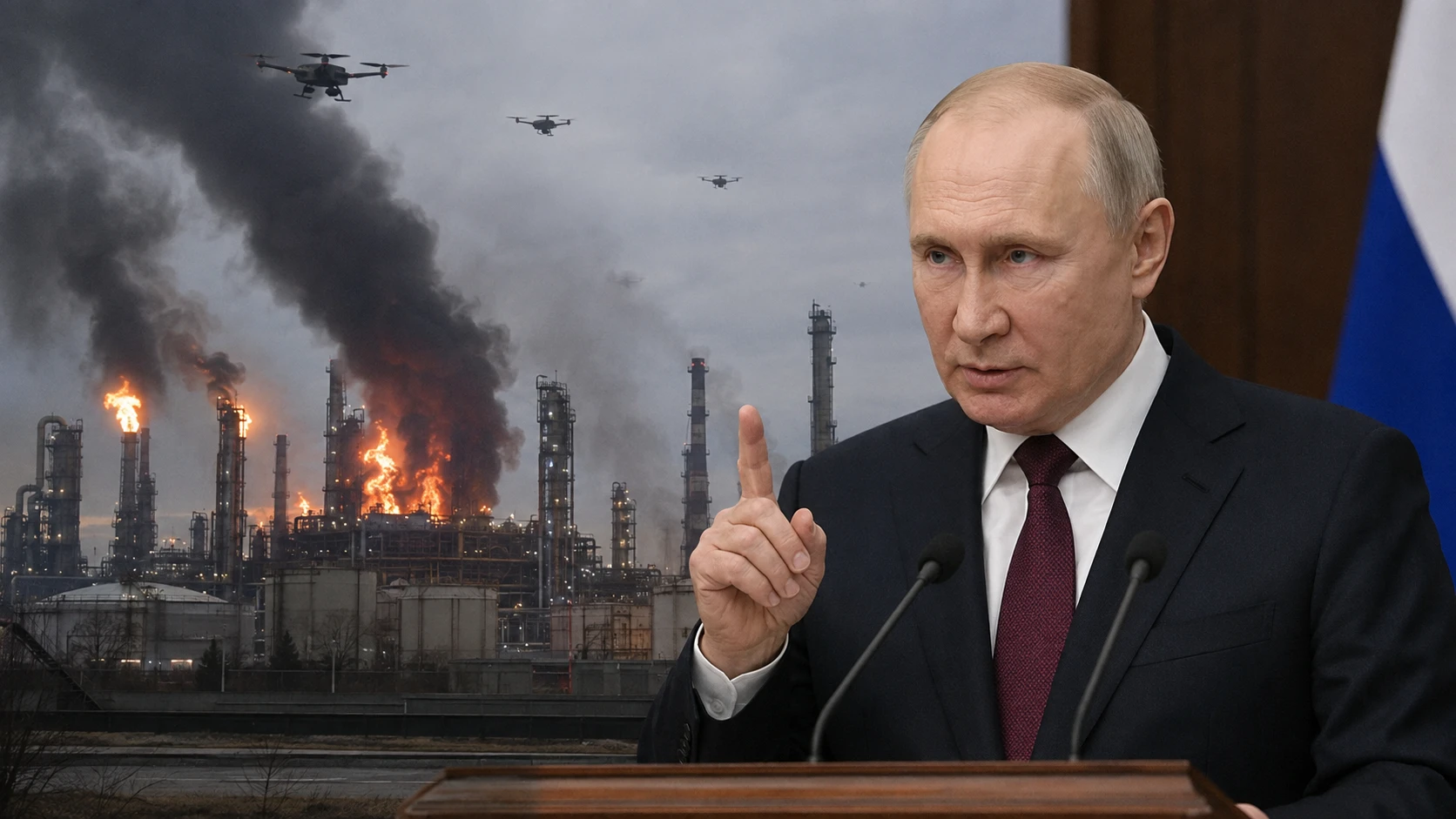
His warning suggests Moscow may increasingly characterize Ukrainian businesses, export facilities and other economically important infrastructure as legitimate retaliatory targets.
At the same time, there is little indication that Ukraine intends to abandon its campaign against Russian refineries and logistics networks.
Instead, both countries appear determined to make the economic consequences of the war increasingly painful for the other.
Nearly four and a half years after Russia launched its full-scale invasion of Ukraine, the conflict is therefore expanding far beyond trenches and traditional military positions.
Factories, refineries, ports, warehouses, shipping routes and energy systems are becoming increasingly central to the fight.
And with Putin now openly warning that Ukraine’s economic targets will be met with Russian attacks against Ukraine’s own economy, the next stage of the war could bring even greater risks—not only for Russia and Ukraine, but also for civilians, international shipping and global commodity markets.





Be the first person to comment.