
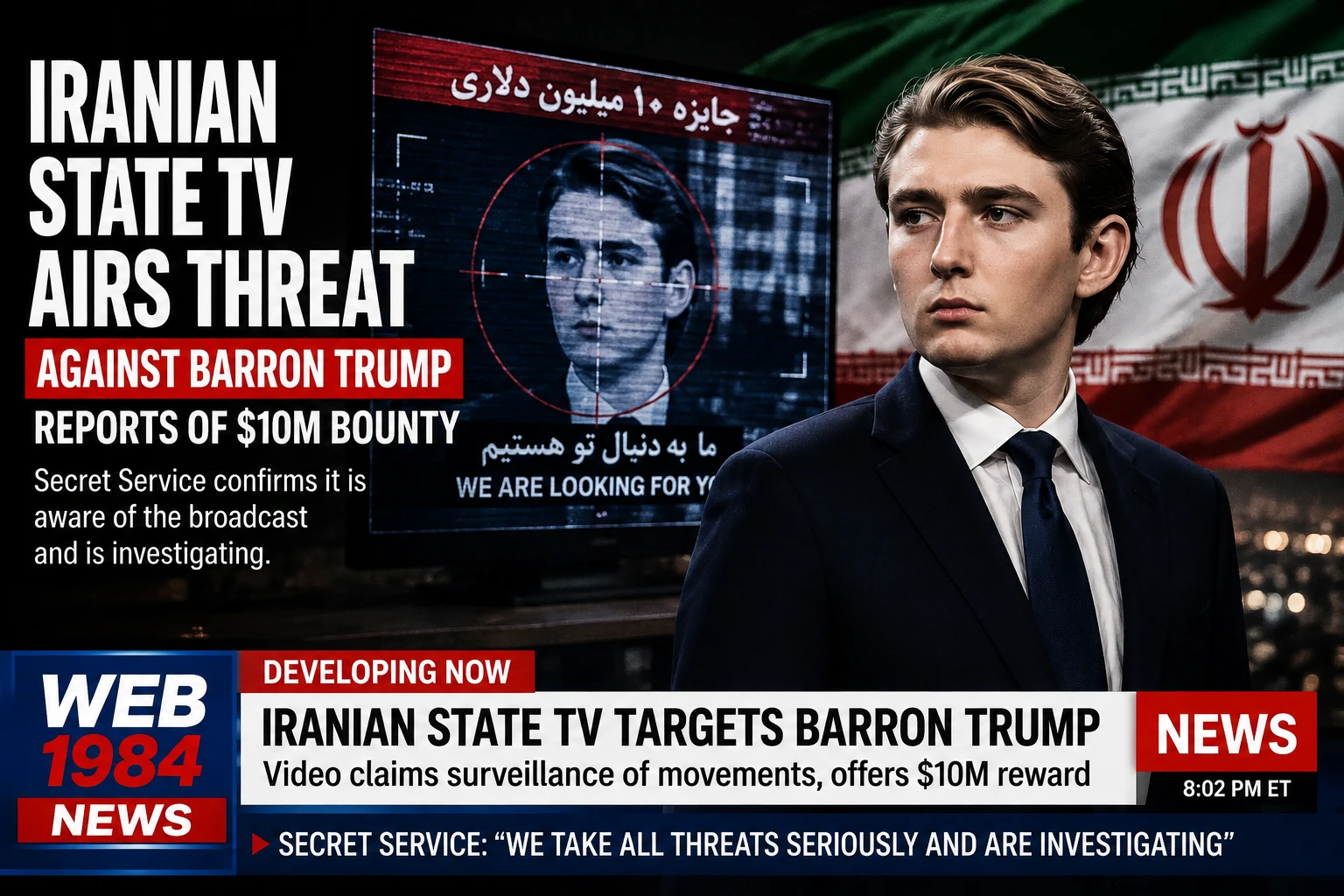
A disturbing video broadcast by Iranian state television targeting Barron Trump, the 20-year-old son of President Donald Trump, has drawn the attention of the U.S. Secret Service as tensions between Washington and Tehran continue to intensify.
The roughly three-minute segment reportedly portrayed Barron Trump as being under surveillance and described purported methods of reaching him despite his Secret Service protection.
The broadcast also referred to a $10 million reward connected to targeting Barron Trump, according to multiple reports.
However, while the broadcast itself has been independently reported and confirmed, there is currently no independent evidence establishing that an actual $10 million bounty has been formally funded or authorized. Euronews reported that the bounty claim and several other assertions made in the Iranian broadcast could not be independently verified.
Secret Service Confirms It Is Investigating
The U.S. Secret Service confirmed Tuesday that it is aware of the Iranian broadcast.
Secret Service spokesman Nate Herring said the agency investigates anything that could be interpreted as a threat against the people it protects.
The agency declined to discuss specific protective measures or intelligence surrounding Barron Trump, citing operational security concerns.
The acknowledgement from the Secret Service gives significant weight to concerns surrounding the broadcast, although it does not validate every claim made in the Iranian video.
Broadcast Allegedly Shows Barron's Movements and Security
According to Euronews and Iran International, the Iranian television segment claimed Barron's movements were being closely monitored.
The production reportedly included imagery and information purporting to show areas surrounding his university, vehicles used by his security detail and locations associated with Secret Service personnel.
Iranian state media also portrayed attempts to map Barron's social connections and online activity.
Iran International reported that the presentation relied heavily on dramatized graphics and offered no independently verifiable evidence that anyone connected to the broadcast had actually penetrated Barron's security.
One particularly alarming claim alleged that an unidentified woman had managed to get close enough to Barron to provide private information to those producing the program.
That allegation has also not been independently verified.
$10 Million 'Bounty' Claim Requires Caution
Several headlines have described the Iranian broadcast as placing a $10 million bounty on Barron Trump's head.
The distinction between what is confirmed and what remains unverified is important.
What is confirmed is that Iranian state television broadcast a threatening segment about Barron Trump and referred to a $10 million reward.
What has not been established publicly is whether the money actually exists, who would supposedly provide it or whether the reward represents an official operational order from the Iranian government.
Euronews specifically noted that it could not independently verify the bounty claim.
Iran International similarly reported that the broadcast mentioned a $10 million reward but provided no proof that its broader operational claims were genuine.
Threats Against Trump's Family Have Become Increasingly Personal
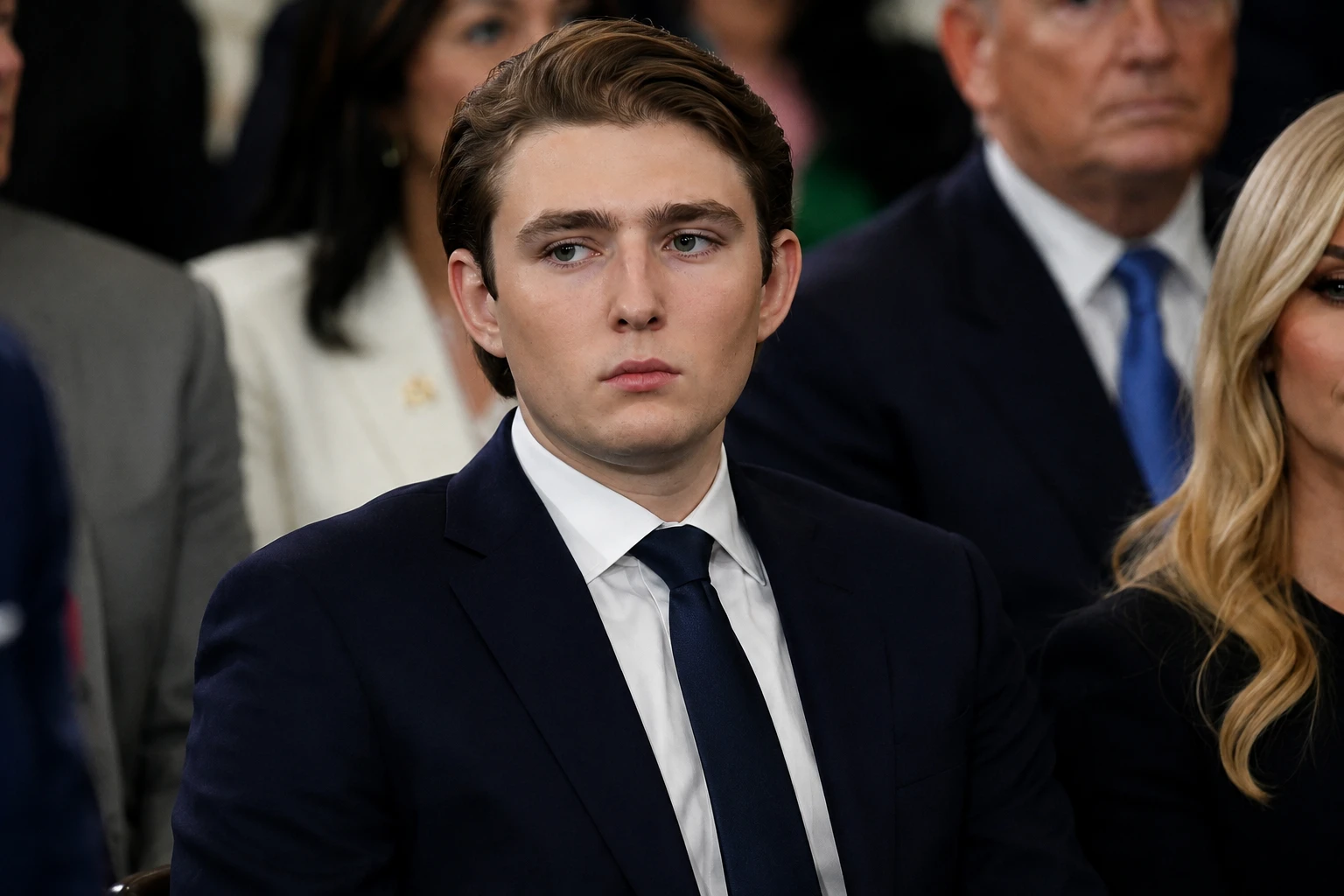
The Barron Trump video appears to be part of a broader pattern of increasingly personal rhetoric in Iranian state-linked media.
Earlier Iranian media content reportedly focused on First Lady Melania Trump and President Trump himself.
Euronews reported that a previous IRGC-affiliated production discussed Melania Trump's movements and alleged vulnerabilities surrounding her security.
Iranian state-linked media has also circulated imagery and messaging threatening President Trump directly.
The latest broadcast represents an especially significant escalation because Barron Trump does not hold government office and does not make U.S. foreign-policy decisions.
Targeting the child of a sitting president introduces a different dimension into the confrontation between the two countries.
U.S.-Iran Tensions Continue to Escalate
The threatening broadcast comes during an extremely volatile period in relations between the United States and Iran.
Washington has continued increasing economic pressure against Tehran.
On August 20, U.S. Treasury Secretary Scott Bessent announced plans for what he described as the toughest sanctions ever imposed on Iran, part of a wider effort by the Trump administration to intensify economic pressure on the Iranian government.
Iranian officials have strongly condemned the economic campaign.
The confrontation comes amid a wider regional conflict and continuing disputes over Iran's nuclear program, economic sanctions, military operations and control of strategically important shipping routes.
The Strait of Hormuz remains particularly significant because a substantial portion of the world's petroleum supply passes through the narrow waterway.
Iran's Calls for Retaliation
Iranian hardliners have repeatedly called for retaliation against President Trump and other American officials.
The hostility has roots stretching back years.
During Trump's first presidency, he authorized the January 2020 U.S. drone strike that killed Iranian Quds Force commander Qassem Soleimani near Baghdad International Airport.
Iranian officials subsequently vowed revenge.
Those threats have intensified again amid the current confrontation between the United States and Iran.
Euronews reported that Iranian state television commentators have recently invoked the Islamic concept of qisas, or retributive justice, in arguing for retaliation against those they consider responsible for Iranian leaders' deaths.
A Serious Security Concern Regardless of the Bounty's Authenticity
Even without verification of the purported $10 million bounty, the decision by a state broadcaster to air a program discussing the killing of the American president's son is extraordinary.
The Secret Service's response demonstrates that U.S. authorities are treating the material as something requiring investigation.
Threat assessments do not depend solely on whether every claim in a propaganda video is accurate.
Security agencies must also consider whether such broadcasts could encourage individuals or groups to act independently.
That makes the distinction between propaganda and an operational plot important—but it does not make the broadcast insignificant.
What We Know
As of August 25, the established facts are:
Iranian state television aired a threatening video focused on Barron Trump. The segment reportedly claimed that his movements and security arrangements were being monitored. It referred to a $10 million reward associated with targeting him. Independent news organizations have not verified that an actual $10 million bounty exists. Several of the surveillance and infiltration claims contained in the program also remain unverified. The U.S. Secret Service has confirmed it is aware of the video and is investigating the threat.
The episode represents another serious escalation in the increasingly hostile rhetoric surrounding the United States and Iran.
But the most important distinction is also the simplest: the threatening Iranian television broadcast is real; the existence of an actual $10 million bounty remains an allegation rather than an independently established fact.

Be the first person to comment.