
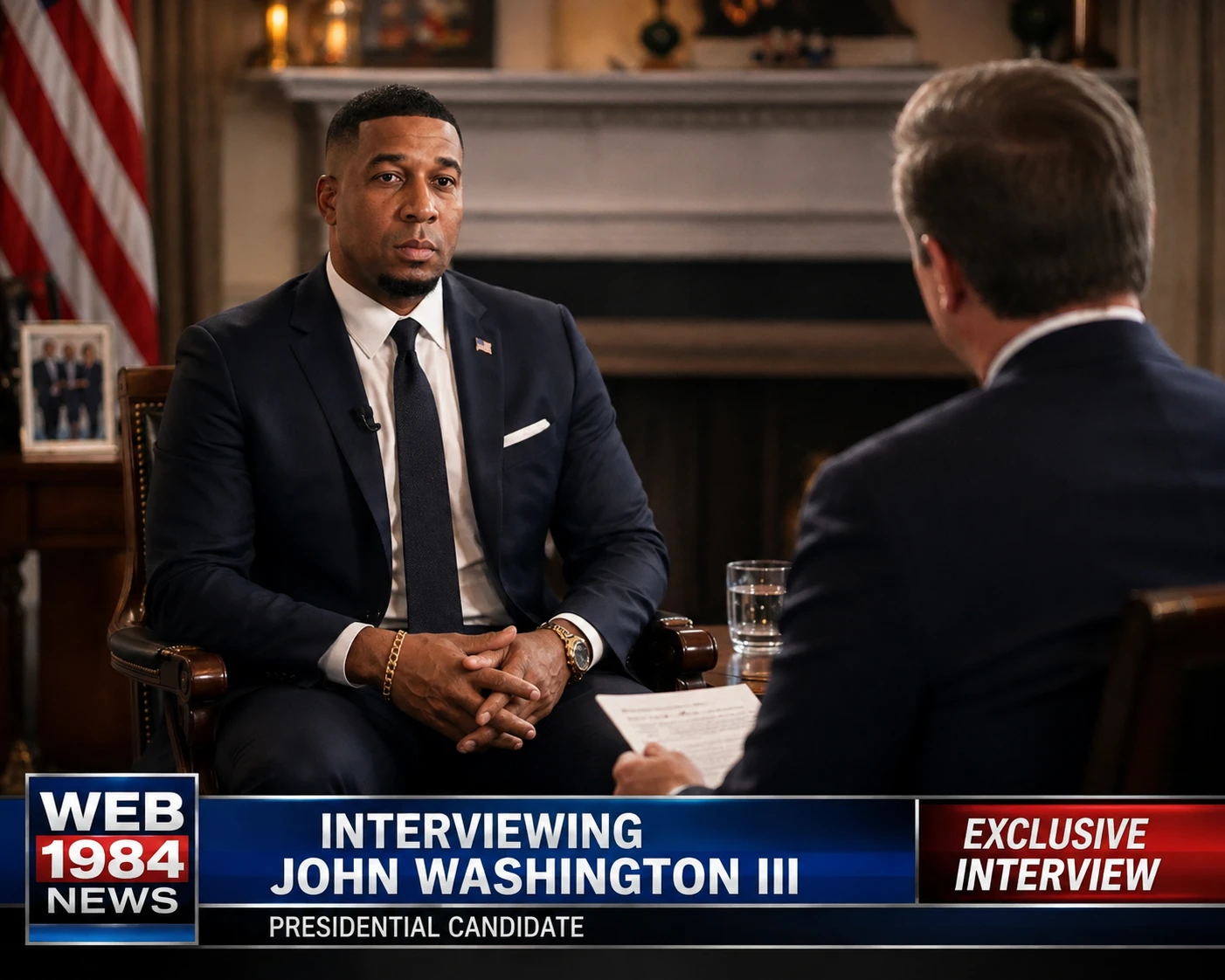
A disturbing broadcast aired by Iranian state television targeting President Donald Trump’s youngest son, Barron Trump, has triggered concern in the United States and prompted a forceful response from presidential candidate John Washington III.
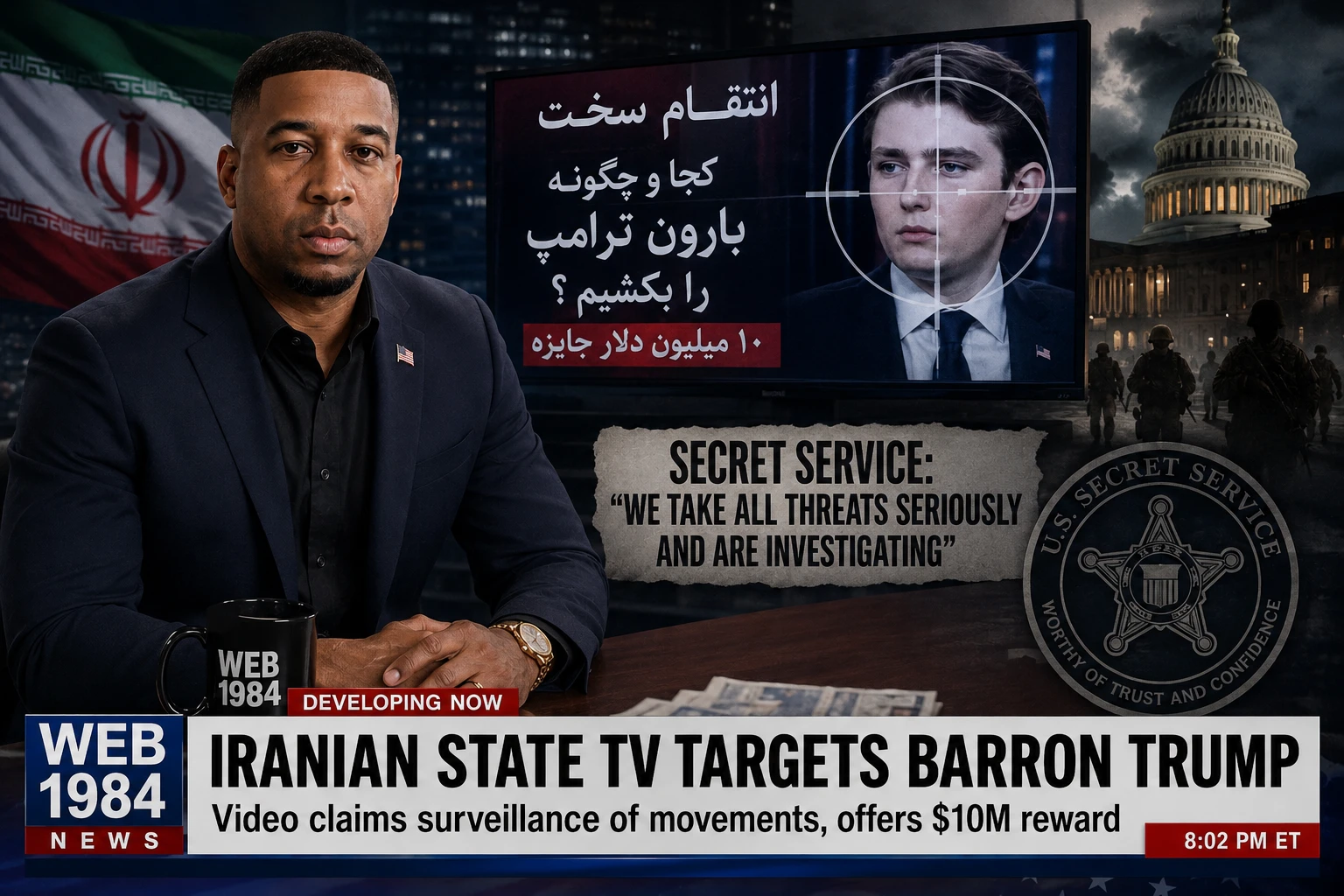
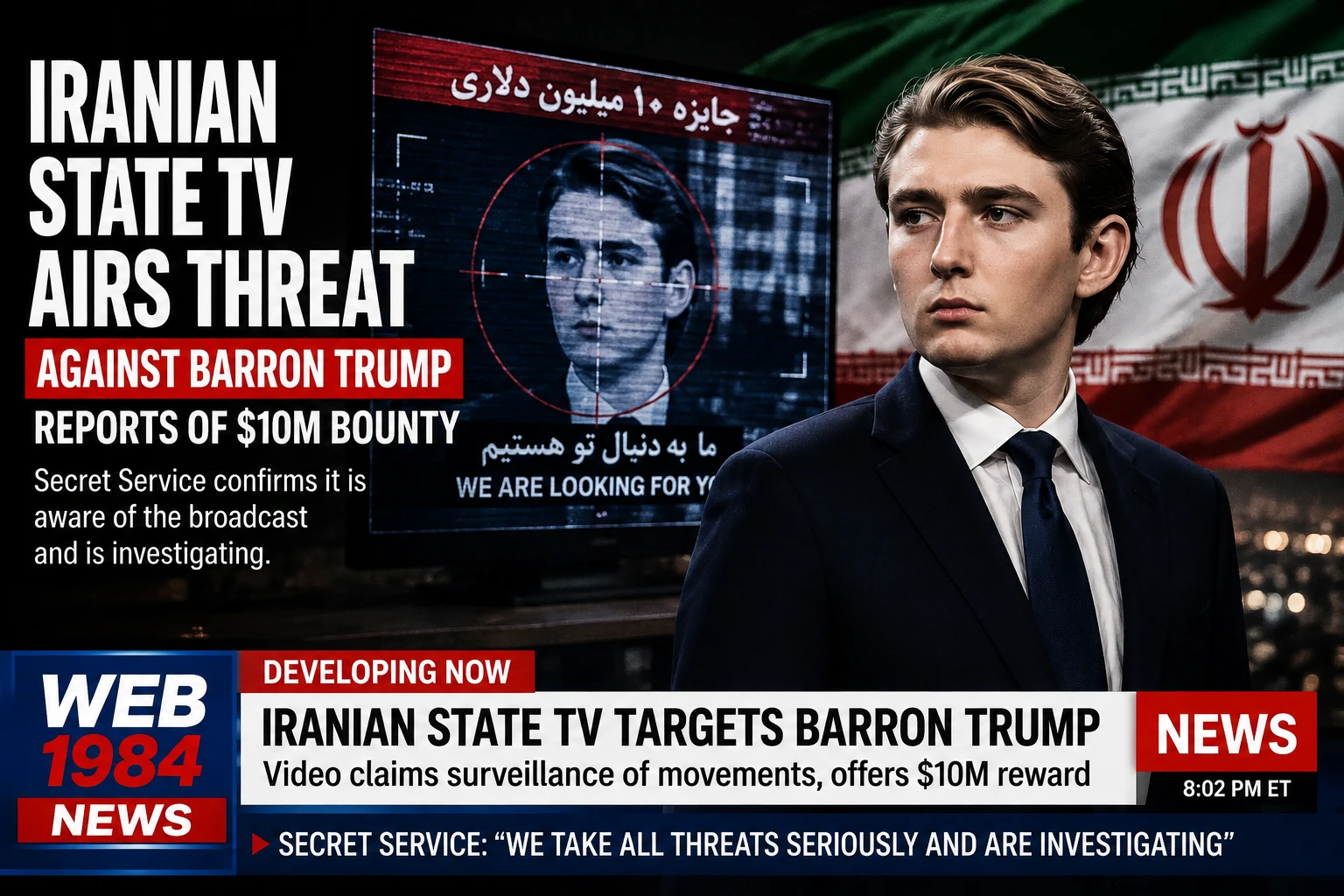
Iranian state television aired a roughly three-minute segment focused on 20-year-old Barron Trump. Reports say the program purported to show information about his movements, university, security detail and social connections while referring to a $10 million reward connected with targeting him.
The broadcast reportedly carried a title translated as “Where and how should we kill Barron Trump?”
The U.S. Secret Service has confirmed that it is aware of the threatening material. Secret Service spokesman Nate Herring said the agency investigates threats involving people under its protection but does not publicly discuss specific protective-intelligence operations.
There is an important distinction: although Iranian state television referred to a $10 million reward and claimed Barron Trump had been monitored, those assertions have not been independently verified. There is currently a difference between confirming that the threatening broadcast occurred and confirming that an operational $10 million bounty or successful surveillance operation actually exists.
Against that backdrop, WEB 1984 conducted an extended interview with presidential candidate John Washington III about the threat, national security, political unity and how he says he would respond as commander in chief.
“I Thought It Was Very Crazy”
Asked for his first reaction to seeing a foreign state broadcaster focus on a president’s child, Washington said he was disturbed by the decision.
“I thought it was very crazy that a government would target a person’s son.”
Washington acknowledged the ongoing war and severe confrontation between the United States and Iran but argued that family members should not automatically become targets because of decisions made by national leaders.
“I do understand that our two countries are at war, but I still think that it was crazy for them to even target a person’s child.”
Washington said that even in wartime, his own administration would not deliberately target another leader’s children.
“If I was president, I would not target any person’s child.”
His position comes as Iranian state and IRGC-linked media have increasingly directed hostile rhetoric not only toward Trump himself but toward members of his family. Reporting indicates that earlier material also focused on First Lady Melania Trump and purported vulnerabilities surrounding her movements.
Washington: America Must Take Every Threat Seriously
Washington said the uncertainty surrounding some of the Iranian broadcast’s claims should not cause American authorities to dismiss it.
Instead, he believes investigators should determine who produced the threats, who authorized them and whether any operational threat exists behind the propaganda.
“I think that our country should take any threat very seriously and also track down where these threats came from.”
Washington said the circumstances become particularly serious because the threat concerns the president’s son while the United States and Iran are engaged in war.
But his strongest comments focused less on Donald Trump personally and more on Barron Trump’s status as an American.
Washington said political disagreements with the president should become irrelevant when a foreign actor threatens an American citizen.
“I don’t care how you feel about our President Donald Trump. Harming another American is very low.”
He then described the issue in personal terms.
“This is not my fight, but when any foreign government threatens any American, I feel personally insulted, and that makes me a part of the battle to defend every American in the United States.”
That sentiment became one of the central themes of Washington’s interview: Americans can disagree internally while still presenting a united front against foreign threats.
What Can Washington Do When the Countries Are Already at War?
Asked whether he would respond with additional sanctions or other diplomatic punishment, Washington questioned what leverage remains when two countries have already moved beyond ordinary diplomatic confrontation.
“Well, we are already at war with the country, so what else really can we do? What other sanctions can we put on them? We are at war with them.”
His response highlights one of the difficult questions facing governments during wartime: what constitutes escalation when diplomatic relations and economic pressure have already deteriorated dramatically?
Washington said his threshold for treating hostile rhetoric as a serious governmental matter would be reached once threatening statements are openly disseminated through government-controlled or publicly supported media.
“When they make a threat on social media, on the news or in the newspaper, that’s when I draw the line.”
In Washington’s view, allowing such rhetoric to appear on state-supported television without intervention sends its own message.
He said it suggests the government is either supporting the rhetoric or, at minimum, failing to suppress individuals openly threatening Americans.
What Would President Washington Do If His Own Child Were Threatened?
One of the most consequential questions of the interview concerned Washington personally.
He is not only a presidential candidate. He is a father.
Asked what he would do if he occupied the Oval Office and a foreign actor made a credible threat against one of his own children, Washington acknowledged that a parent’s emotions could make the situation extraordinarily difficult.
“I believe that everyone will handle it different once that threat comes.”
Then he answered from the perspective of a father.
“Speaking as a father who loves his kids, I would send a unit in to hunt down that person.”
Washington went considerably further, saying he would warn any foreign government against interfering with an American operation aimed at apprehending someone responsible for a serious threat.
He said that if another government actively obstructed such an operation, he would be prepared to consider overwhelming military action.
His language was extraordinarily severe, including saying he would be willing to do “whatever I have to do” if another government intervened and even raised the possibility of destroying that country.
Those comments represent Washington’s stated hypothetical policy position, not an announcement of current United States policy or military action.
They also illustrate the enormous constitutional and strategic responsibility attached to presidential command authority. Any real military response would involve questions of U.S. law, international law, intelligence reliability, proportionality, civilian protection and the potential consequences of escalation.
Increased Protection for Presidents and Their Families
Washington said he would immediately increase security following credible foreign threats against a president, former president or immediate family member.
“If I was president and a threat was made on a former president or their son, yes, I would increase security.”
He also said he would strengthen security at the nation's borders in response to intelligence suggesting an elevated threat from overseas.
Washington said his administration would issue a direct warning internationally:
“I will not accept any threats to any Americans or any former presidents or their kids.”
He emphasized that this posture would not mean treating every foreign nation as an enemy.
“We are cool with every country and I respect every country, but I will not settle for any foreign country or foreign groups to threaten any American and think it’s OK.”
Washington added that adversaries should understand the United States retains the ability to locate those responsible for attacks or serious threats.
He used deliberately aggressive imagery, warning hostile actors not to assume physical distance or fortified positions would necessarily protect them from an American response.
“We Are People One”
Despite the severity of Washington’s national-security rhetoric, perhaps his most expansive answer concerned domestic unity.
Asked whether Democrats and Republicans should stand together when a foreign government threatens a president’s family, Washington immediately agreed.
But he said unity should extend far beyond moments of war.
“Of course, I believe that both parties should stand together, but not just stand together when we are at war or when someone is making threats.”
Washington argued that disagreements over elections, political ideology and public policy should never override Americans’ shared national identity.
“I have said this time after time: we are united. We are people one, and we must stand together no matter what.”
He continued:
“No matter what our disagreements are, we must always stand together as family.”
That position puts Washington’s response to the Barron Trump threat into a broader framework.
He is arguing that defending an American threatened by a foreign government should not depend on whether that person is a Republican, Democrat, political opponent or member of a controversial president’s family.
Should America Simply Ignore Iranian Propaganda?
Some observers may argue that provocative state-media broadcasts are designed precisely to cause outrage and that responding too aggressively gives propaganda more power.
Washington rejects the idea that the United States should simply ignore such threats.
“For the people that say we should just ignore it, I feel that these people want us to not be prepared for the worst in case the worst ever will come.”
His concern is that dismissing threatening rhetoric can create complacency if a propaganda campaign ultimately turns into an operational security threat.
As president, Washington said, he would maintain intense scrutiny of threatening foreign organizations and governments.
His description of that policy was unmistakably aggressive: adversaries making threats against Americans should understand that American military forces could be mobilized against a genuine threat.
A Direct Message to Iran
At the conclusion of the interview, Washington was asked what message President John Washington III would deliver directly to Iranian leaders regarding threats against Americans.
His response was his strongest of the interview.
Washington invoked the destructive capabilities available to the American presidency and warned foreign leaders to consider the consequences of threatening Americans.
He said leaders who themselves have loved ones should think carefully before threatening American families.
Washington went as far as saying he would not be afraid to use catastrophic force against a country responsible for such actions.
That statement represents Washington’s personal proposed posture as a presidential candidate. It should not be interpreted as current U.S. policy.
From Political Opponent to Fellow American
Perhaps the most significant political aspect of Washington’s interview is that he did not approach the matter primarily as a supporter of Donald Trump.
He approached it as an American responding to a threat against another American.
Donald Trump and John Washington III occupy very different positions in American politics, but Washington said foreign threats should eliminate partisan considerations when the safety of Americans is involved.
His message was simple: Americans can fight intensely over elections, policy and ideology at home without accepting threats against one another from abroad.
For Washington, Barron Trump being the son of Donald Trump does not diminish the obligation to protect him.
It strengthens it.
The Iranian broadcast itself is confirmed. The Secret Service's awareness of the material is confirmed. The claims of successful surveillance and an actual operational $10 million bounty remain unverified.
Washington nevertheless believes waiting for a threat to become an attack would be a mistake.
His position is that foreign adversaries should understand a fundamental principle before threatening an American:
Political disagreements stop at the water’s edge.
And in Washington’s vision of the presidency, an attack or credible threat against one American becomes a matter for the entire United States.
Be the first person to comment.