
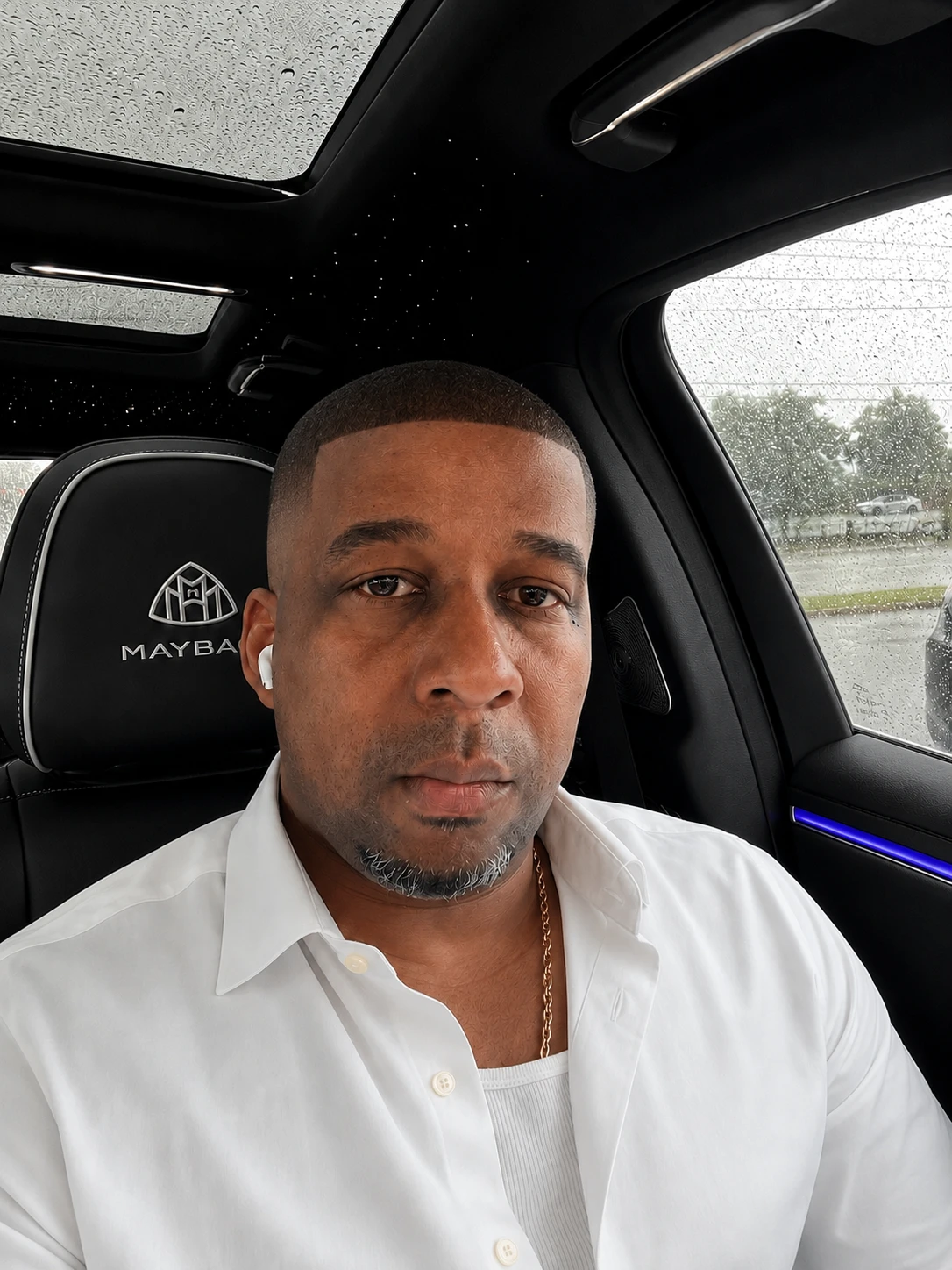
SAN ANTONIO, Texas — For John Washington III, creating music has never been limited to releasing a song, putting out an album and waiting to see what happens next.
Washington says his music catalog has now grown to more than 200 albums, representing years of songwriting, recording, artist development, publishing and independent releases. But the music tells only one part of a much larger story.
Behind the catalog is an entrepreneur attempting to build an interconnected group of companies spanning music, technology, publishing, media, software, financial services and entertainment. And beyond business, Washington is increasingly tying that work to another ambition: a political career focused on changing how institutions serve ordinary Americans.
What began with music is becoming something much larger.
A Massive Independent Music Catalog
The sheer size of Washington's reported catalog immediately distinguishes his approach from that of the typical independent artist.
Rather than concentrating exclusively on a handful of singles, Washington has pursued volume and ownership—building a library of songs and albums intended to remain available for years.
Washington says the catalog connected to him and his companies now exceeds 200 albums, including projects released under his own performing name as well as music created for numerous additional artists.
Public music services confirm that the catalog extends well beyond one artist profile.
Under the recording name JOHN WASHINGTON lll, releases such as HOOD MADE MILLIONAIRE list John Washington III as composer, lyricist, executive producer and background vocalist, while American King Records is identified as the record label.
That distinction is important.
John Washington III is not simply approaching the music industry as a recording artist. His public credits show him operating behind the recordings as a songwriter, composer, producer and executive producer.
The catalog becomes significantly larger when other performers are considered.
Qobuz, for example, lists Washington as composer and lyricist across the 14-track Omari Zayvex album Still Built Different, released through American King Records.
On Zay Vonnix's 16-track Hear Me Now, Washington is credited as producer, executive producer, lyricist and composer, while American King Publishing appears in the publishing credits.
Other independently distributed albums similarly carry John Washington III songwriting or ownership credits. Amazon Music lists projects by artists including Omari Drelix, Kaivon Zytrell, Trevion Sykon, Zaylen Virell, Davon Klyrex, Corey Langston and others with copyrights attributed to John Washington III.
Taken together, those credits illustrate something larger than a personal discography.
They reveal the beginnings of a music catalog business.
American King Records and the Ownership Strategy
At the center of Washington's music operation is American King Records.
The label appears repeatedly in commercial music databases attached to albums where Washington performs, writes or produces.
For Washington, the strategy is built around ownership.
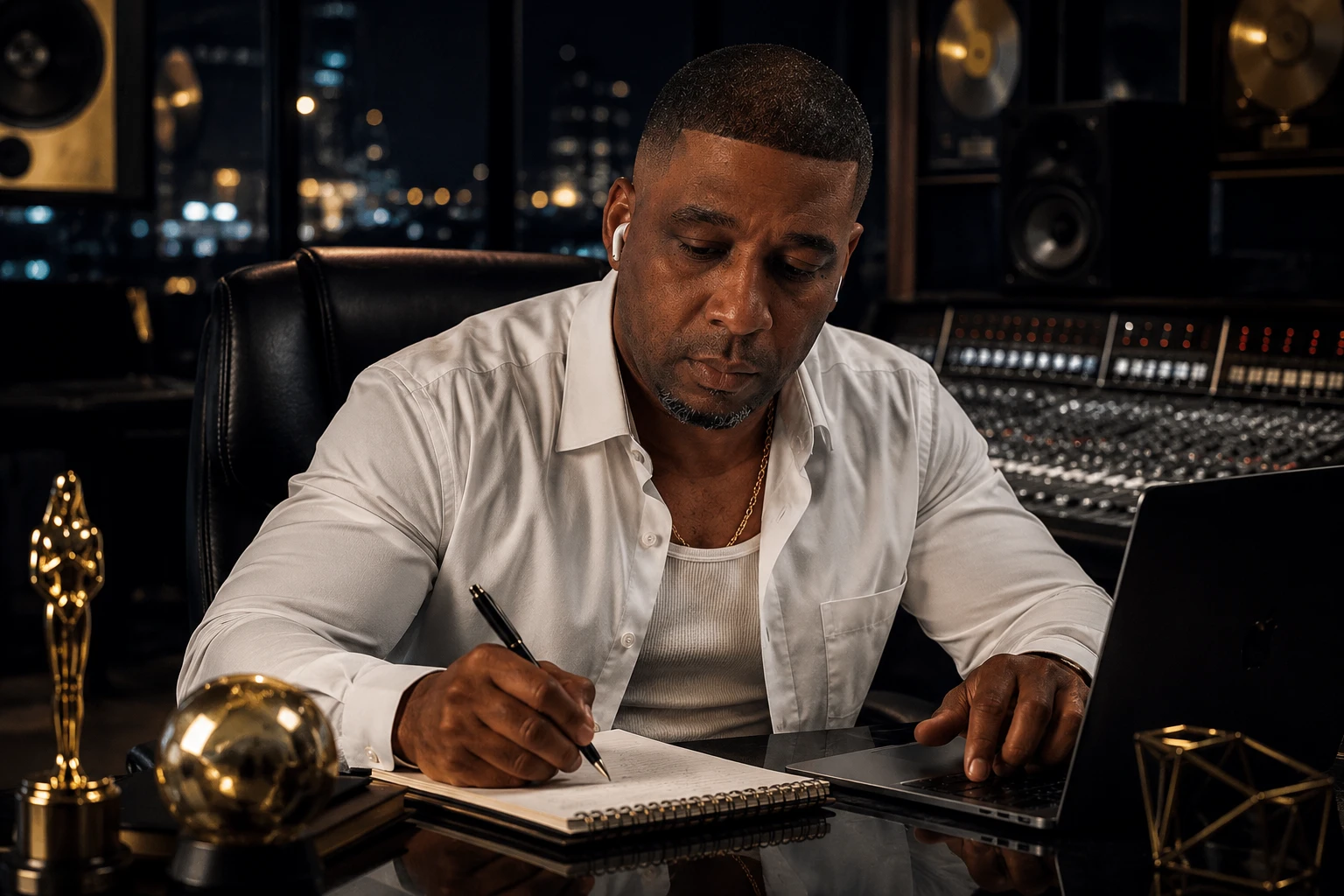
Instead of thinking exclusively in terms of the immediate success of a particular release, he has focused on accumulating intellectual property: recordings, compositions, artist catalogs and publishing interests.
That is a fundamentally different way of viewing music.
A song can generate value through streaming, licensing, publishing royalties, performance royalties and other uses for years after its original release. A large catalog therefore becomes an asset library rather than simply a collection of creative projects.
With more than 200 albums by Washington's own count, the long-term opportunity is not dependent on a single record becoming a hit.
It is based on scale.
One album might contain 10 songs. Another might contain 15 or 18. Multiply that across hundreds of projects and the result can become a substantial library of copyrighted material.
The public catalog already demonstrates that strategy. Albums such as No Love in Sight by Dequon Varnyx contain 15 tracks with Washington identified as lyricist and composer throughout the project.
It is an assembly-line philosophy applied to creativity: write, produce, release, register, distribute, own—and then repeat.
Building Infrastructure Around the Music
Washington's ambitions, however, extend beyond operating a record company.
He has also been developing Music Helmet, a music-technology platform designed around many of the administrative problems independent artists and songwriters encounter after they create a song.
The broader concept includes music-registration tools, catalog management, songwriter workflows, distribution functions, document storage, rights and royalty management, payment tools and artificial-intelligence-assisted music creation.
The idea is straightforward: instead of forcing an independent creator to use a dozen disconnected systems, Washington wants to place more of the music-business workflow inside a single environment.
That philosophy mirrors what he has done personally.
Washington has spent years learning different portions of the music industry—distribution, publishing, royalty registration, catalog organization, artist development and digital services—and has increasingly attempted to turn those processes into software that other creators could use.
In that sense, his large catalog has functioned as both a creative body of work and a laboratory.
Problems encountered while managing hundreds of releases become potential software features.
American King Publishing
Washington's expansion into publishing follows the same ownership philosophy.
Through American King Publishing, his goal is to control and administer the songwriting side of the catalog in addition to the master recordings.
Public music credits already show American King Publishing associated with releases where Washington serves as songwriter and producer.
That distinction matters because the recording and the underlying composition are separate intellectual-property assets.
For Washington, building both sides of the business means attempting to create a structure where songs are not merely released—they are documented, registered, managed and retained as long-term assets.
WEB 1984 and the Move Into Media
Music is only one piece of Washington's expanding digital strategy.
Another project he has been developing is WEB 1984, envisioned as a web, search and media platform with an increasingly significant news operation.
Washington's concept goes beyond publishing occasional articles. He has described a system that can support contributors, reporters, editors, breaking-news coverage, live broadcasts, reporter profiles and independent journalism.
The motivation fits his larger philosophy: instead of continually relying on existing gatekeepers, build infrastructure.
That approach also creates overlap between Washington's entrepreneurial and political interests.
Owning media technology means understanding how information is created, indexed, distributed and discovered—issues that are increasingly central to business, culture and politics.
QuarderNet: Thinking Beyond Individual Websites
Washington has also been developing QuarderNet, his most ambitious technology concept.
Rather than viewing it as simply another website, Washington has described QuarderNet as a larger technology ecosystem—a core intelligence and infrastructure layer capable of eventually supporting multiple applications and services.
The concept has included account systems, secure data, long-term user memory, software services, search, communications and other interconnected technology.
His goal is to build the underlying infrastructure first and allow individual products to connect to it.
That is a markedly different ambition from launching a conventional app.
It is an attempt to create a digital ecosystem.
Quarder Studios and Entertainment Technology
Washington's entertainment ambitions have also expanded beyond recorded music.
Through the concept of Quarder Studios, he has explored creating a private digital movie studio capable of supporting script development, character creation, scenes, voices, video production and eventually commercial video-production services.
The broader vision resembles a virtual production company: one environment where stories can move from an idea to a finished entertainment product.
For someone whose business career began heavily around music, the expansion into film is a natural extension.
Songs are intellectual property.
Films are intellectual property.
Software is intellectual property.
Brands are intellectual property.
Washington's increasingly consistent business philosophy is to create and own assets rather than simply consume services built by somebody else.
One Entrepreneur, Multiple Industries
That philosophy explains why Washington's ventures do not stay confined to a single category.
His projects have touched music, publishing, financial technology, communications, media, artificial intelligence, transportation concepts and entertainment.
Some remain developing concepts, while others have already produced publicly distributed products and music.
What connects them is not necessarily the industry.
It is the ownership model.
Washington wants to build systems.
American King Records is a system for music.
American King Publishing is a system for compositions and rights.
Music Helmet is envisioned as infrastructure for creators.
WEB 1984 is being developed around information and media.
QuarderNet is aimed at broader technology infrastructure.
Quarder Studios extends the model into film and video.
Seen individually, the projects might appear unrelated.
Seen together, they reveal a much larger strategy.
From Entrepreneur to Political Candidate
Washington's ambitions eventually reach beyond entrepreneurship.
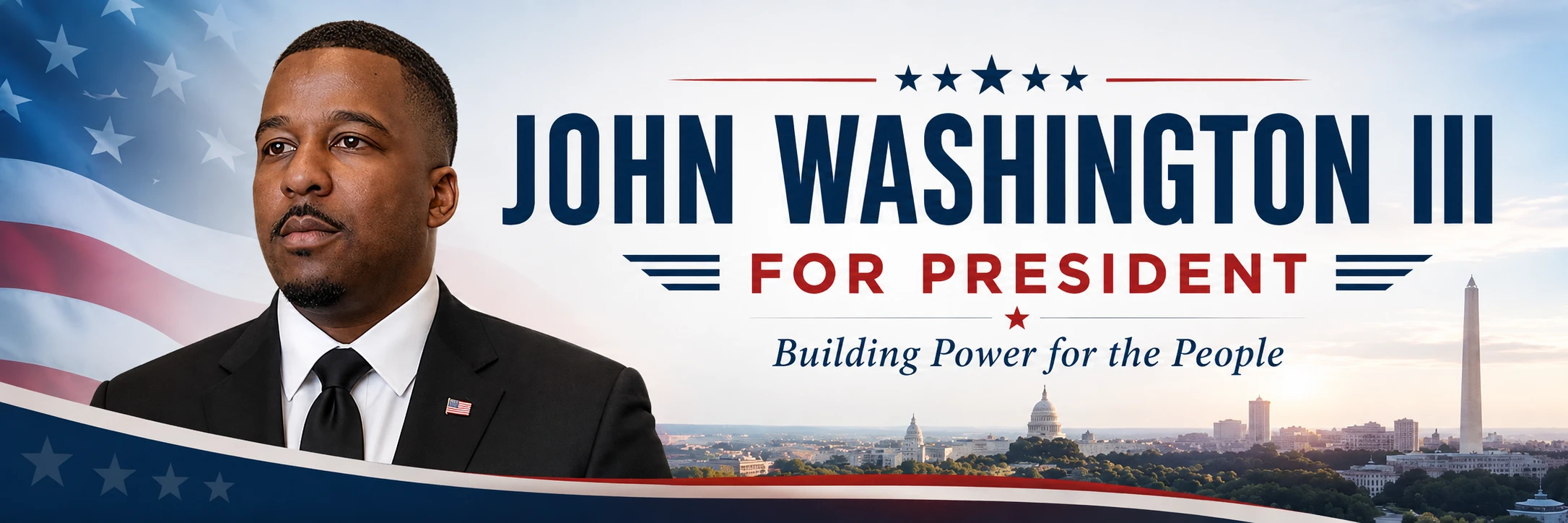
He has publicly identified himself as a candidate for President of the United States in 2028.
His Live With John Washington podcast describes him as a 2028 presidential candidate and presents the program as a forum for discussing government, civil rights, economics, national security, political accountability and the future of the country.
The transition from entrepreneur to political candidate is central to the next stage of Washington's story.
He argues that many of the same principles that shaped his business philosophy—independence, accountability, building systems from the ground up and questioning established institutions—also influence the way he thinks about government.
Washington's political message has increasingly centered on the idea that government exists to work for citizens, rather than requiring citizens to continually fight through institutions simply to receive fair treatment.
He has spoken about civil rights, government accountability, economic opportunity and strengthening the relationship between citizens and the institutions created to serve them.
And unlike a political career built entirely inside government, Washington wants his entrepreneurial record to be part of his argument.
His position is essentially: look at what I build.
Building Before Asking for Power
That may ultimately be the most unusual part of Washington's political strategy.
He is not waiting for elected office to begin building.
He is building companies.
He is building technology.
He is building media infrastructure.
He is building a music catalog.
He is building intellectual property.
And he is attempting to build platforms that could eventually serve people far beyond his own businesses.
Whether every idea reaches its ultimate scale remains to be seen. Entrepreneurship is filled with experiments, pivots and projects that evolve dramatically from their original concepts.
But the scale of Washington's ambition is difficult to miss.
More than 200 albums, by his count, are not the result of producing one project and stopping.
Neither are multiple technology platforms, a record company, publishing initiatives, media projects and entertainment concepts.
They reflect repetition.
Build something.
Learn from it.
Improve it.
Build the next thing.
The Larger Vision
For John Washington III, the individual company may ultimately matter less than the ecosystem connecting everything together.
Music can connect to publishing.
Publishing can connect to rights management.
Rights management can connect to financial technology.
Artists can connect to media.
Media can connect to search and technology.
Technology can connect businesses, creators and consumers.
And eventually, Washington believes the lessons learned while constructing those systems can inform how he approaches public leadership.
That is where his entrepreneurial career and political career intersect.
Washington is attempting to position himself not merely as someone with ideas about what should change, but as a builder who believes institutions themselves can be redesigned.
The massive music catalog came first.
The businesses followed.
The technology grew around them.
Now the political career is becoming another chapter.
And if Washington's plans unfold the way he envisions them, the story of more than 200 albums will eventually be remembered not as the culmination of his work—but as the foundation on which he built everything that came next.



Be the first person to comment.