

One part of Kamala Harris's record that I believe Americans need to understand is her history with school truancy.
And I want to be accurate about what happened.
Harris began her major anti-truancy initiative while she was San Francisco district attorney, before she became California attorney general. Her office worked with schools and families and ultimately prosecuted parents in what it described as the most severe cases of chronic truancy. She also sponsored legislation that became California's SB 1317 in 2010, creating criminal penalties for parents or guardians who failed to reasonably supervise and encourage the school attendance of chronically truant children.
The law allowed misdemeanor prosecution that could expose parents to fines and potentially jail. Parents were later arrested—and in some California counties, jailed—under the statewide approach Harris had championed. Harris subsequently said she regretted those outcomes and described the criminalization of some parents as an unintended consequence.
To be equally clear, reports examining Harris's original San Francisco program found that parents prosecuted there were not actually sent to jail. That distinction matters because I don't believe in twisting somebody's record just because I disagree with them.
But I still believe the underlying philosophy deserves serious criticism.
A Child Missing School Does Not Automatically Mean the Parent Committed a Crime
Think about an ordinary working parent.
A mother gets up in the morning.
She makes sure her child is dressed.
She feeds that child.
She watches that child leave the house and get on the school bus.
Then she goes to work believing her child is sitting in a classroom.
What happens if that child decides to skip?
What happens if a teenager gets off somewhere else?
What happens if that child goes to a friend's house, a restaurant, a field, a shopping center or somewhere else instead of going to class?
Should the first instinct of government be to threaten that parent with criminal prosecution?
I say no.
There is an enormous difference between a parent deliberately refusing to educate a child and a parent doing everything reasonably expected of them while their child makes a decision behind their back.
Government should understand that difference.
Truancy absolutely needs to be addressed. Children need an education. Chronic absenteeism can destroy educational opportunities and can be a warning sign that something much deeper is happening in a child's life.
But that is exactly why I believe the first question should be:
Why isn't this child in school?
Not:
Who can we prosecute?
Maybe the child is being bullied.
Maybe there is a mental-health problem.
Maybe there are transportation problems.
Maybe the family is homeless.
Maybe the child has a disability.
Maybe the parent works two jobs.
Maybe the student is caring for another family member.
Maybe the child simply keeps skipping school despite everything the parent is doing.
Find the problem.
Then fix the problem.
Harris's own later work as attorney general increasingly emphasized attendance tracking, intervention, family services and identifying the underlying causes of absenteeism, not simply punishment. Her California Justice Department also reported that low-income children and Black students were disproportionately affected by chronic absence.
To me, that reinforces the point: these situations are often more complicated than saying, “Your child missed school, so punish the parent.”
We Cannot Criminalize Our Way Out of Every Social Problem
This is one of the biggest disagreements I have with the traditional political system.
Government sees a problem, and too often the answer becomes another law, another fine, another court case, another criminal charge or another person facing jail.
At some point America has to ask whether that actually solves the problem.
A parent who is already struggling financially doesn't become a better parent because government puts another fine on the kitchen table.
A mother doesn't become more capable of watching her child by being taken away from that child.
A family doesn't become stronger because the parent now has a criminal record.
And locking somebody up who did not hurt, rob, assault or threaten another person should never be treated casually.
If there is genuine abuse or neglect, deal with it.
If someone is intentionally preventing a child from receiving an education, investigate it.
But prosecution should be the extraordinary response—not the automatic hammer government reaches for whenever a social problem appears.
Harris's Prosecutorial Record Has Raised Other Questions Too
I am not the first person to question Kamala Harris's record.
Criminal-justice reform advocates have debated her career for years. Some critics considered portions of her record too punitive, including the truancy policy, decisions by her office involving disputed convictions and her approach to police-accountability issues. As California attorney general, she also defended the state's death-penalty system in court despite personally opposing capital punishment, something supporters characterized as performing the legal duties of her office and critics viewed as a contradiction.
That doesn't mean every accusation made against Kamala Harris on social media is true. Some aren't.
It also doesn't erase parts of her record that supporters legitimately point to.
Harris created the Back on Track diversion program for certain nonviolent offenders, pursued major cases involving for-profit colleges and reached significant settlements involving financial institutions after the foreclosure crisis. Reuters characterized her overall prosecutorial career as a mixture of reform-oriented policies and tough-on-crime approaches.
People deserve to know both sides.
Then they can make their own judgment.
Being a Woman Does Not Put a Politician Above Scrutiny
Kamala Harris has been an important figure in American history. She became the first woman to serve as vice president of the United States and broke barriers that many Americans never thought they would see broken.
That deserves acknowledgment.
But representation cannot mean immunity from accountability.
You can celebrate a woman reaching one of the highest offices in America and still question the decisions she made while exercising government power.
You can support women's rights and still ask whether a particular politician's policies harmed mothers.
You can be a Democrat and question another Democrat.
You can be Black and question another Black politician.
Nobody gets a free pass because of race, sex, party, title or popularity.
I don't want Americans choosing leaders because somebody told them, “She's for women.”
I don't want them choosing somebody because they're Republican.
I don't want them choosing somebody because they're Democrat.
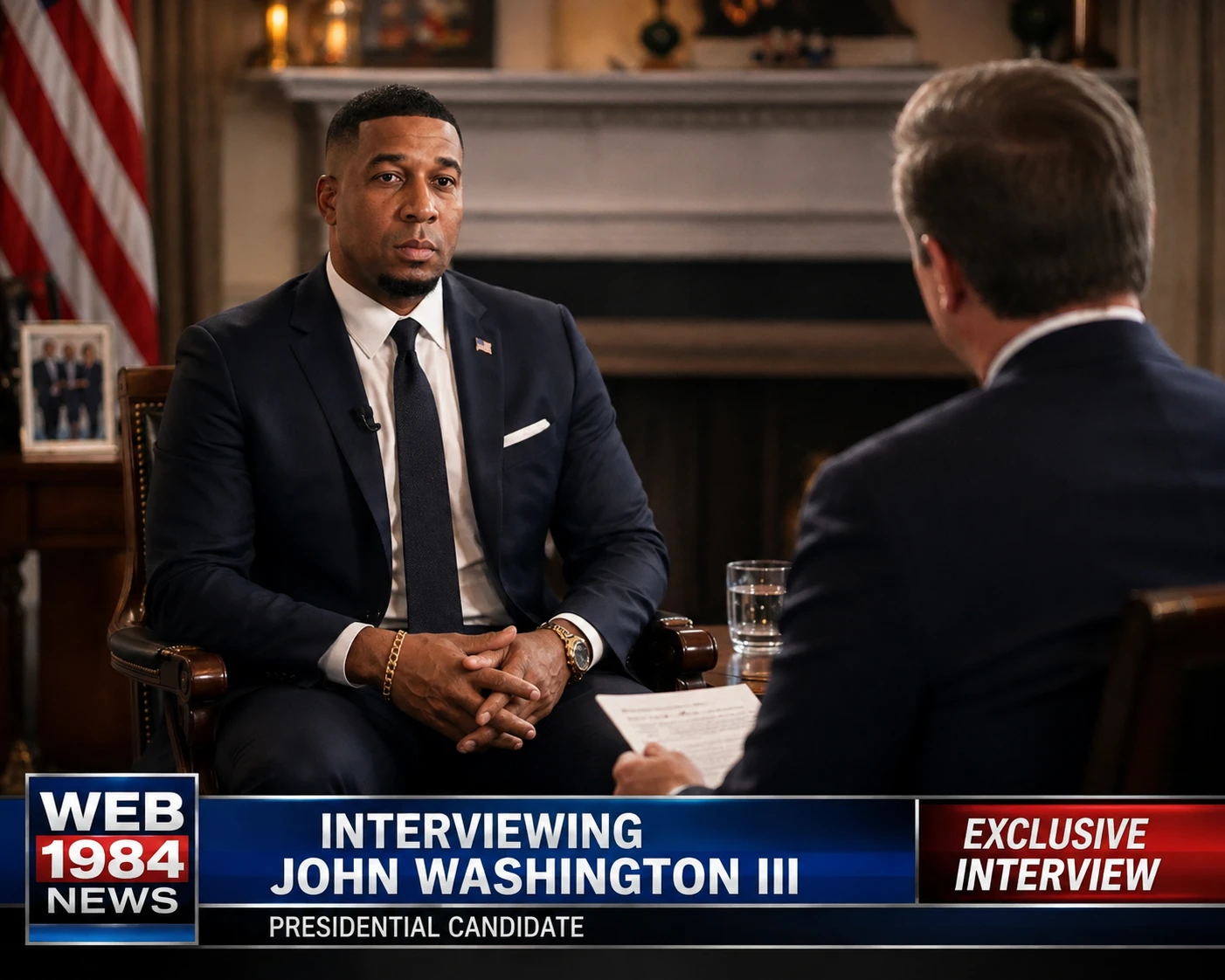
And I don't want anybody choosing John Washington III simply because I tell them I'm for the people.
Look at my record.
Question me.
Challenge me.
Make me explain my policies.
Then do exactly the same thing to everybody else who asks for your vote.
The Government Should Work for Families, Not Against Them
My position is simple.
If a parent puts their child on that school bus and reasonably believes that child is going to school, government should not automatically turn around and treat that parent like a criminal because that child made another decision.
Bring the parent in.
Bring the school in.
Talk to the student.
Look at transportation records.
Look at attendance patterns.
Find out what happened.
Provide intervention when intervention is needed.
Provide counseling when counseling is needed.
Hold the student accountable when appropriate.
Hold a genuinely neglectful parent accountable when the evidence proves neglect.
But understand the difference between a struggling family and a criminal family.
Those are not the same thing.
I Need Americans to Start Looking Deeper
This is what I mean when I tell people they need to understand how the system works.
Don't stop at the campaign commercial.
Don't stop at the speech.
Don't stop because somebody says, “I'm fighting for you.”
Follow the record.
Look at the legislation.
Look at who could be fined.
Look at who could be arrested.
Look at who actually suffered the consequences.
Then ask whether the politician standing in front of you today would make the same decision tomorrow with the power of the presidency.
I am not telling Americans that they have to hate Kamala Harris.
I'm telling Americans something much more important:
Know who you're supporting.
You may examine her entire record and still support her. That is your right.
You may examine it and decide you disagree with her. That is your right too.
But don't let political parties, television networks, social media, celebrities—or even another politician—do your thinking for you.
America needs people who are awake, informed and willing to question everybody who holds power.
Because when government makes a mistake, ordinary people are the ones who usually live with the consequences.
And when I'm president, I want government looking for ways to solve the problem before it looks for somebody to punish.
— John Washington III Candidate for President of the United States, 2028




Be the first person to comment.