
There are moments in American history that are difficult to read about because they force us to confront an uncomfortable reality: government institutions are made up of human beings, and human beings can abuse power.
One of those moments occurred during Prohibition.
In 1926, the federal government intensified requirements that industrial alcohol be “denatured”—made undrinkable by adding toxic or foul-tasting chemicals. Industrial alcohol was legally manufactured for products such as solvents, cosmetics, fuel, and antifreeze, but bootleggers were diverting some of it, attempting to remove the denaturing chemicals, and selling it illegally as drinking alcohol. Historical and medical sources confirm that the federal government mandated poisonous additives, including methanol, as part of its effort to make this alcohol unsuitable for human consumption.
This history needs to be stated carefully. The government was not manufacturing ordinary legal drinking liquor and secretly poisoning bottles on store shelves. Prohibition had outlawed most beverage alcohol. The government was requiring industrial alcohol—alcohol that was legally supposed to be undrinkable—to contain denaturants. Bootleggers then diverted some of that industrial alcohol into an illegal drinking market.
But that distinction does not erase the troubling question.
Government officials knew people were drinking diverted industrial alcohol. Yet the poisoning requirements became more severe. A January 1927 TIME report described a new federal denaturing formula that doubled the amount of poison manufacturers were required to use, while Americans were already dying from contaminated alcohol.
A contemporary 1926 TIME report described the struggle between federal authorities and bootleggers as a kind of “chemical warfare”: government chemists were trying to make industrial alcohol impossible to convert into drinkable liquor while bootleggers tried to remove the chemicals.
The National Library of Medicine has likewise summarized the historical record by noting that in 1926 the federal government required poisonous substances, including methanol, to be added to industrial alcohol in an effort to discourage its consumption.
That leads me to a question I believe every American has the right to ask:
If our government was once willing to knowingly pursue a policy that exposed its own citizens to deadly substances in order to enforce a law, what guarantees that government power could never again be abused in another form?
I am not asking Americans to believe every conspiracy theory. I am asking Americans to study documented history.
There is a difference.
Black Wall Street: Another Warning From History
Five years before the poisonous-alcohol controversy, one of the darkest events in American history occurred in Tulsa, Oklahoma.
Greenwood was a prosperous Black community so successful that it became known as Black Wall Street.
On May 31 and June 1, 1921, Greenwood was attacked and devastated. Homes and businesses were looted and burned. Black residents were killed, displaced, detained, and stripped of property.
For generations, many Americans learned an incomplete version of what happened.
But in 2025, the United States Department of Justice released an extensive review of the Tulsa Race Massacre. Its findings are extremely important.
The Justice Department found that Tulsa police deputized hundreds of white residents, including men who had been agitating for the lynching of Dick Rowland. Law-enforcement officials helped organize these newly deputized men and others into forces that eventually attacked Greenwood. The DOJ further found credible reports that some law-enforcement officers participated in murder, arson, and looting.
The Oklahoma Historical Society similarly reports that Tulsa's police chief deputized hundreds of white men, gave them authority, and that some subsequently participated in the destruction of Greenwood.
We should distinguish local and state authorities from the federal government here. It would be inaccurate simply to say that “the federal government destroyed Black Wall Street.” But government officials and government authority unquestionably played a disturbing role in what happened.
That distinction matters because truth matters.
And the truth itself is bad enough.
Tuskegee: Government Betrayal in the Name of Science
Then there was Tuskegee.
Beginning in 1932, the U.S. Public Health Service worked with the Tuskegee Institute on a study involving hundreds of Black men in Alabama.
According to the Centers for Disease Control and Prevention, informed consent was not obtained. The men were told they were being treated for “bad blood.” When penicillin became an effective and widely available treatment for syphilis, participants with the disease were still not offered that treatment.
The study continued until 1972.
Forty years.
Eventually, an advisory panel concluded that the study was ethically unjustified, and it was terminated. President Bill Clinton formally apologized to survivors in 1997.
Following Tuskegee and other abuses, federal protections for human research were strengthened, including requirements involving informed consent and independent review boards.
That is an important part of this history too: America sometimes responds to injustice by creating safeguards designed to prevent its repetition.
But safeguards survive only when people insist that they be respected.
My Question as a Presidential Candidate
As a candidate for President of the United States, I believe one of the President's most important responsibilities should be protecting the people from abuses of power—including abuses committed by their own government.
So I ask Americans a serious question:
If government institutions have crossed moral lines before, should citizens simply assume they could never cross another one?
I don't believe the proper response to history is blind distrust of everything government does.
But neither do I believe the proper response is blind trust.
Government should earn trust.
That means transparency.
It means independent oversight.
It means whistleblower protections.
It means meaningful congressional scrutiny.
It means a free press.
It means courts capable of reviewing government conduct.
It means citizens having access to government records wherever national-security or legitimate privacy concerns do not require secrecy.
And when government harms innocent people, it means admitting the truth instead of protecting institutions from embarrassment.
The Dangerous Words: “That Could Never Happen Here”
Every generation likes to believe it is more enlightened than the generation before it.
People today look backward and ask:
How could officials have allowed that?
How could doctors have participated in Tuskegee?
How could law enforcement have participated in what happened in Greenwood?
How could policymakers continue a policy involving poisonous industrial alcohol when they knew people were consuming it?
Those are fair questions.
But there is another question that matters even more:
What policies happening during our own lifetime will future generations look back upon and ask us the same thing about?
That does not mean we accuse officials without evidence.
It means we investigate.
We demand documentation.
We demand accountability.
We protect people's constitutional rights.
And we refuse to treat government agencies as though they are incapable of wrongdoing simply because they carry an official seal.
Government Is Supposed to Serve the People
The American system was never supposed to be based on the idea that citizens must trust government without question.
Government derives its legitimacy from the people.
Government officials are public servants.
The people are not servants of the government.
When institutions forget that relationship, abuse becomes possible.
Our history gives us enough documented examples to understand why oversight matters.
The poisoned-industrial-alcohol controversy of Prohibition is real.
The government misconduct surrounding the Tulsa Race Massacre is documented.
The Tuskegee study is documented.
These aren't reasons to fear everything.
They are reasons to pay attention.
Could It Happen Again?
This is the question I want Americans discussing:
If government power has been abused before, could it happen again—perhaps not in exactly the same way, but through different technology, different agencies, different policies, or different justifications?
My answer is that no generation should assume itself immune from government abuse.
That is why constitutional protections matter even when they are inconvenient.
That is why due process matters.
That is why freedom of speech matters.
That is why transparency matters.
That is why citizens must be allowed to question their government without automatically being dismissed simply for asking difficult questions.
At the same time, we must remain disciplined enough to separate documented facts from rumors. If we accuse government of wrongdoing, we should demand evidence. If evidence proves wrongdoing, we should demand accountability.
That combination—skepticism with evidence—is stronger than either blind trust or blind suspicion.
As President, that is the standard I would want America to follow.
We should never be afraid of the truth about our history.
We should learn from it.
Because the most important promise government can make isn't simply:
“Trust us.”
It is:
“You have the right to question us, investigate us, expose wrongdoing, and hold us accountable.”
That is how a government of the people should operate.
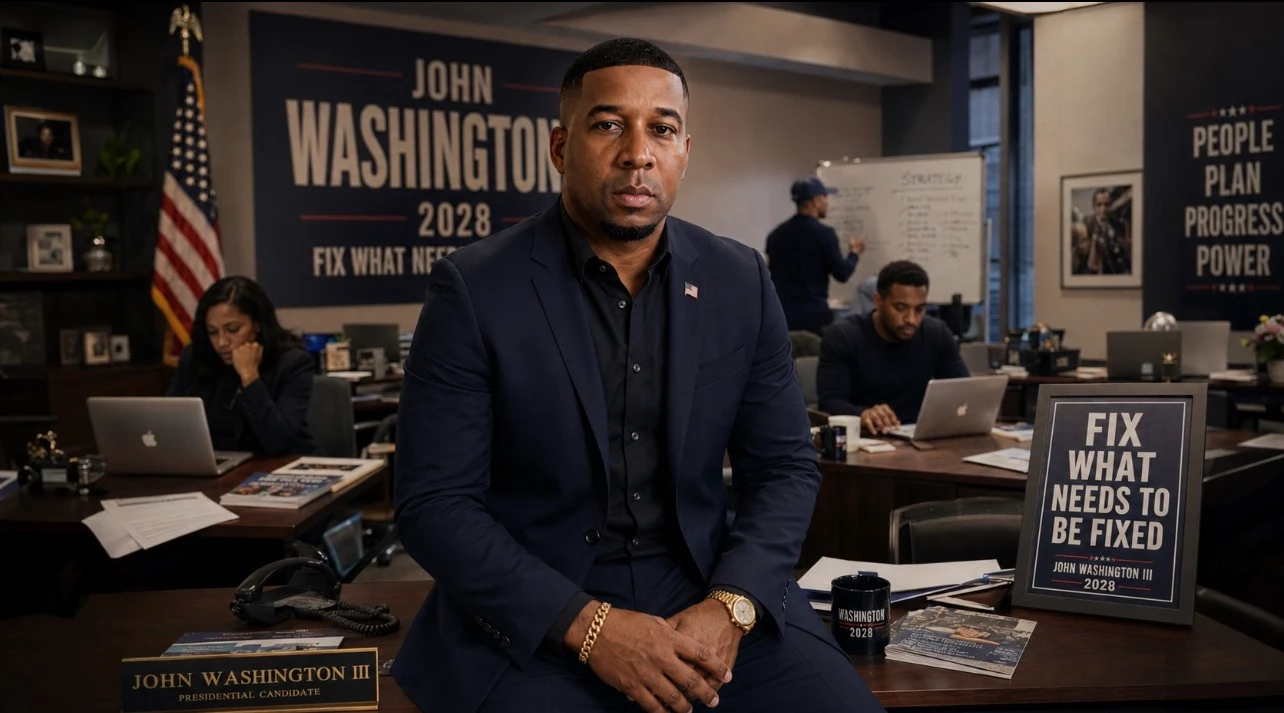
John Washington III Candidate for President of the United States

Be the first person to comment.