

There are certain words in the Constitution that Americans hear so often that we can begin to stop hearing them at all.
We repeat them. We quote them. We teach them in classrooms. Lawyers cite them. Judges interpret them. Politicians invoke them. Yet sometimes the most familiar language can contain questions that remain worth asking.
For me, one of those questions is found in the final four words of the Tenth Amendment to the Constitution of the United States:
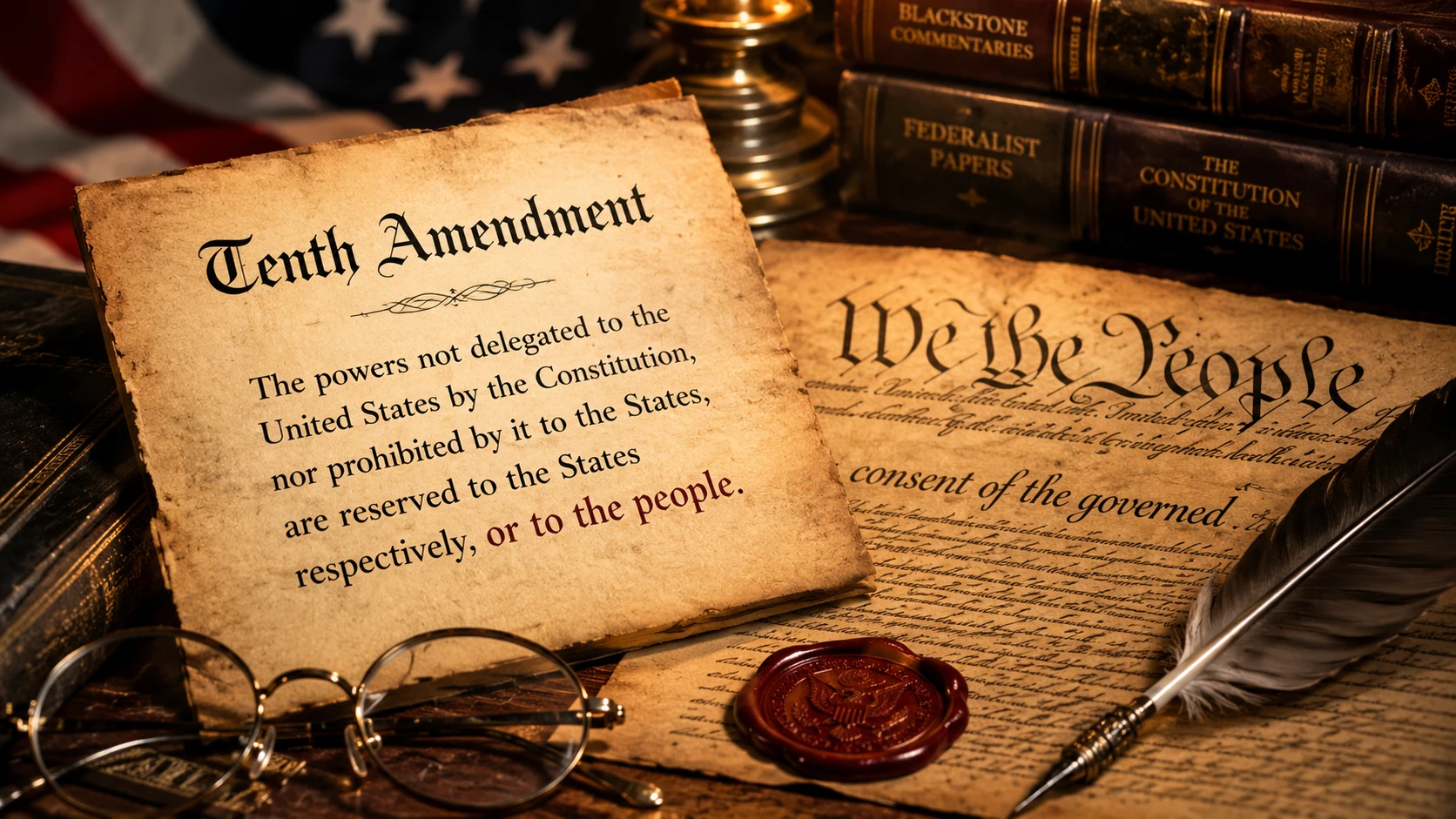
“The powers not delegated to the United States by the Constitution, nor prohibited by it to the States, are reserved to the States respectively, or to the people.”
The entire amendment is only one sentence:
“The powers not delegated to the United States by the Constitution, nor prohibited by it to the States, are reserved to the States respectively, or to the people.”
Every word in that sentence deserves attention.
The amendment does not say that every power not given to the federal government belongs automatically to state governments.
It says those powers are reserved “to the States respectively, or to the people.”
That distinction is what I want Americans to examine.
I am not arguing that modern courts have accepted a legal theory under which citizens may simply override state governments whenever they believe a particular power belongs directly to the people. They have not. The prevailing constitutional framework gives state governments extremely broad authority over matters not assigned to the federal government, subject to the limitations imposed by the Constitution.
Nor am I suggesting that four words can be removed from the rest of the Constitution, isolated from more than two centuries of judicial interpretation, and turned into whatever rule someone happens to prefer.
My argument is more fundamental.
I am asking whether American constitutional thought has given enough independent meaning to the phrase “or to the people.”
And if it has not, I believe the time has come for scholars, judges, lawmakers, attorneys, students, candidates, and ordinary citizens to start discussing what those words were intended to preserve.
The Constitution Begins With the People
Before we even reach the Tenth Amendment, we should remember how the Constitution begins:
“We the People.”
It does not begin, “We the federal government.”
It does not begin, “We the States.”
It does not begin, “We the legislatures.”
It begins with the people.
That was not accidental.
The American system rests on a principle that was revolutionary in the eighteenth century and remains revolutionary today: government does not create the people’s authority. The people create the government’s authority.
Government possesses delegated power.
The people possess original political sovereignty.
That concept also runs through the Declaration of Independence, which states:
“Governments are instituted among Men, deriving their just powers from the consent of the governed.”
Those words establish an important sequence.
First come the governed.
Then comes their consent.
Then comes government.
The government does not exist first and graciously distribute freedom downward.
The political community exists first, and legitimate governmental authority flows upward from it.
That is one of the central philosophical claims on which the American experiment was built.
If that principle still means what we say it means, then we should be careful not to collapse “the people” into “the government.”
They are related.
They are connected.
One derives legitimacy from the other.
But they are not constitutionally identical.
Government Is an Entity; the People Are the Source of Its Authority
A state government is an institution.
It has agencies.
It has officials.
It has courts.
It has a legislature.
It has an executive branch.
It has administrative departments.
It has a treasury.
It can sue and be sued.
It can own property.
It can enter contracts.
It can enact statutes.
It can prosecute crimes.
It can regulate conduct.
It survives individual officeholders.
Governors leave office, but the state government continues.
Legislators retire, but the legislature remains.
Judges die or resign, but the judicial institution survives them.
In that sense, government has an institutional existence separate from any particular citizen.
But where does its rightful authority come from?
From the people.
That is the constitutional relationship that interests me.
The people and their government cannot be treated as completely interchangeable concepts because one is supposed to be the source of the other’s authority.
When we say that government exists by the consent of the governed, we necessarily recognize a distinction between the governing institution and the human beings from whom its legitimacy is derived.
That distinction matters when reading the Tenth Amendment.
If the framers had intended every undelegated power to belong to the governments of the states, they could have ended the amendment after the phrase “reserved to the States respectively.”
They did not.
They added:
“or to the people.”
Why?
That is not a rhetorical trick.
It is a constitutional question.
Words in a Constitution Should Not Be Treated as Surplus
One of the oldest principles of legal interpretation is that words in an important legal text generally should not be treated as meaningless if a reasonable interpretation gives them effect.
That does not mean every word creates an independent lawsuit.
It does not mean every phrase creates an unlimited substantive right.
But it does mean we should hesitate before treating constitutional language as decorative.
The Tenth Amendment identifies three locations in the constitutional distribution of power:
the United States,
the States,
and the people.
The federal government receives delegated powers.
Certain powers are denied to the states.
The remainder is reserved either to the states or to the people.
That structure appears to recognize something beyond a simple two-part division between federal power and state power.
Yet much modern discussion of the Tenth Amendment reduces it to precisely that binary:
If the federal government does not have a power, the states do.
That may often be the correct practical conclusion.
But the text itself says something slightly more complicated.
It says:
the States respectively, or the people.
Those last words force us to ask whether there are dimensions of constitutional authority that do not belong to either governmental sovereign in the ordinary institutional sense.
What Could “Reserved to the People” Mean?
This is where humility is important.
There are several possible interpretations.
The phrase could be understood primarily as a statement of popular sovereignty—a reminder that government authority ultimately originates with the people.
It could recognize that certain retained liberties remain outside ordinary governmental power.
It could refer indirectly to political powers exercised by the people themselves through constitutional conventions, elections, amendments, petitions, referenda where available, and other democratic mechanisms.
It could reinforce the broader philosophy reflected in the Ninth Amendment, which warns that enumerating particular rights should not be interpreted to deny or disparage other rights retained by the people.
Or the phrase could carry several of these meanings at once.
I am not claiming that I can resolve that debate in a single essay.
I am saying the debate deserves to exist.
Because if “the people” in the Tenth Amendment merely means “the state governments,” then we should explain why the Constitution uses two different expressions.
And if they are not identical, then the American constitutional conversation should take that difference seriously.
The Ninth and Tenth Amendments Sit Beside Each Other for a Reason
Consider the Ninth Amendment:
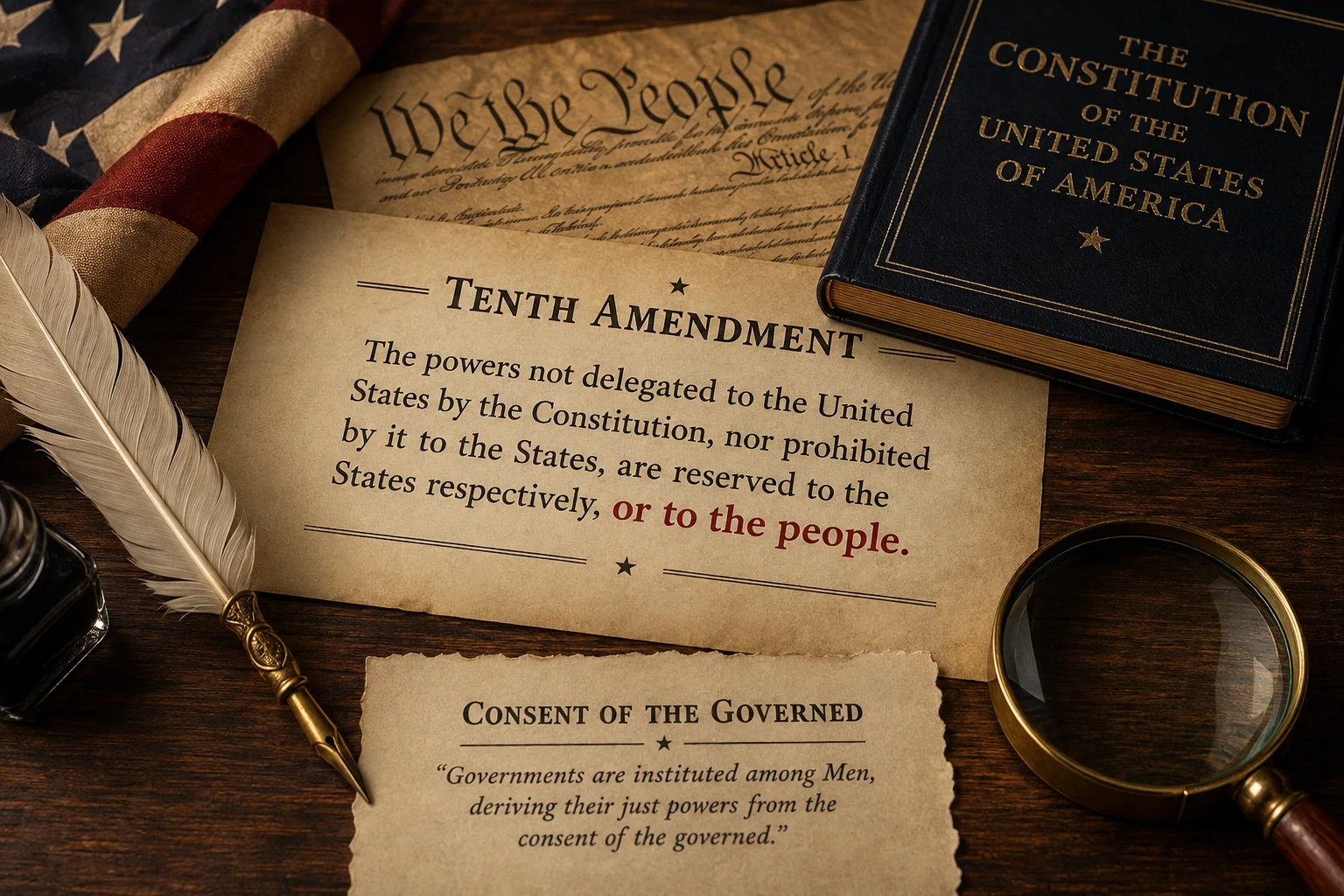
“The enumeration in the Constitution, of certain rights, shall not be construed to deny or disparage others retained by the people.”
Then immediately comes the Tenth Amendment:
“The powers not delegated to the United States by the Constitution, nor prohibited by it to the States, are reserved to the States respectively, or to the people.”
The Ninth Amendment speaks of rights “retained by the people.”
The Tenth Amendment speaks of powers reserved “to the States respectively, or to the people.”
I do not believe we should casually erase the recurring constitutional presence of the people themselves.
The Bill of Rights was not written merely as an organizational chart for competing governments.
It was also written because Americans feared concentrated political authority.
The founding generation had experienced a government that claimed powers they believed had not been legitimately granted.
Their response was not merely to create a different government.
It was to create a system in which governmental authority would be divided, constrained, enumerated, checked, balanced, and ultimately grounded in popular sovereignty.
That history does not automatically prove any particular modern legal claim.
But it should affect how seriously we take constitutional language describing powers and rights retained by the people.
A State Is Not the Same Thing as Its People
This distinction becomes especially important when Americans use the word “state.”
Sometimes we mean the geographic community.
Sometimes we mean the population.
Sometimes we mean the governmental apparatus.
Those are not always the same thing.
When someone says, “Texas decided,” what do they mean?
Did approximately thirty million Texans personally decide?
Did the Legislature decide?
Did the governor decide?
Did an administrative agency decide?
Did a state court decide?
Did voters approve a constitutional amendment?
Did a local government act under state authority?
Language can hide important differences.
A state government acts in the name of the people.
But acting in the name of the people is not the same as literally being the people.
That is true at every level.
Congress represents Americans.
Congress is not identical to the American people.
A president is elected by the constitutional process established by the people.
The president is not the people.
A governor exercises authority under a state constitution.
The governor is not the people.
A judge interprets law established through constitutional institutions.
The judge is not the people.
Government officials are trustees of public authority.
They are not its ultimate source.
And that source distinction matters.
Consent of the Governed Cannot Be Merely Ceremonial
The Declaration of Independence is not itself the operative Constitution, and courts do not generally treat every phrase of the Declaration as an independently enforceable legal command.
That distinction must be respected.
But the Declaration expresses the political philosophy that justified American independence and influenced the constitutional order that followed.
Its statement that governments derive “their just powers from the consent of the governed” raises a question that every generation should consider:
What does consent mean in a constitutional republic?
Surely it does not mean that every citizen must personally approve every law.
Representative government could never function under such a rule.
A law does not become unconstitutional simply because I disagree with it.
A citizen cannot announce, “I did not consent,” and thereby exempt himself from generally applicable law.
That would replace constitutional government with individual veto power.
But the opposite extreme is also dangerous.
If “consent of the governed” means nothing more than that government may do whatever established institutions decide to do, subject only to occasional elections, then the concept risks becoming ceremonial.
The American tradition demands something deeper.
Consent is institutionalized through constitutions.
Through elections.
Through representation.
Through amendment processes.
Through juries.
Through due process.
Through petitions.
Through freedom of speech.
Through freedom of assembly.
Through the ability to challenge government action in court.
Through federalism.
Through the separation of powers.
Through the reserved rights and powers of citizens.
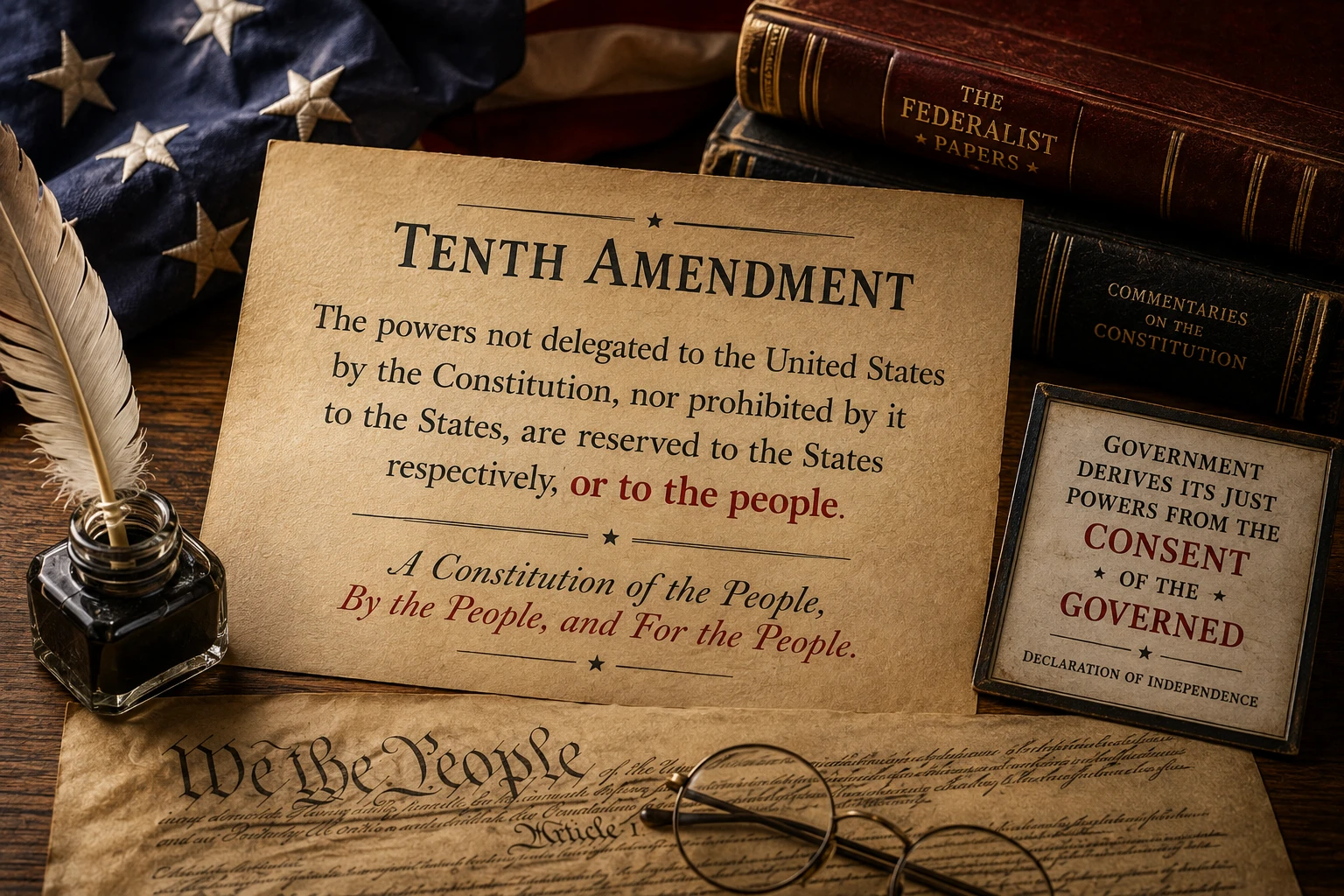
That structure exists because the government is supposed to remain subordinate to the constitutional order created by the people.
The Federal Government Has Enumerated Powers
One of the central structural principles of the Constitution is that the federal government is a government of delegated powers.
Congress does not possess a general police power simply because it believes a policy would be useful.
Federal laws ordinarily require a constitutional foundation in one or more of Congress's enumerated powers or other constitutional provisions.
Over time, Supreme Court doctrine has interpreted several federal powers broadly, especially the Commerce Clause, the taxing and spending powers, and the Necessary and Proper Clause.
But the underlying principle remains:
The national government is not supposed to possess every conceivable governmental power.
The Tenth Amendment reinforces that structure.
Where I think our discussion becomes incomplete is when we immediately assume that everything outside federal jurisdiction necessarily belongs without qualification to a state governmental institution.
The actual constitutional text leaves another category:
the people.
State Governments Possess Broad Reserved Authority
We should be accurate about current law.
Under the prevailing constitutional structure, states possess broad general governmental authority.
States regulate criminal law, property law, family law, contracts, professional licensing, land use, education, public safety, elections subject to federal constitutional requirements, and countless other areas.
The Supreme Court has repeatedly recognized this broad sphere of state authority.
Modern courts have not generally interpreted the final words of the Tenth Amendment as establishing a free-standing individual right allowing a person to invalidate state legislation merely by arguing that a power should have been “reserved to the people.”
That is not the doctrine we have today.
I want that stated clearly because constitutional debate becomes less credible when people describe aspirational arguments as though they were already binding precedent.
They are not.
If someone walked into federal court today and argued simply, “The Tenth Amendment says ‘or to the people,’ therefore this state law is unconstitutional,” that argument by itself would almost certainly be insufficient.
Courts would look for a recognized constitutional violation: perhaps due process, equal protection, freedom of speech, the right to keep and bear arms, protection from unreasonable searches, voting rights, federal preemption, or some other established constitutional doctrine.
My argument is not that the judiciary secretly agrees with my interpretation.
My argument is that constitutional meaning is worth discussing even when existing doctrine has not fully developed a particular idea.
Every major constitutional doctrine began with somebody asking what the Constitution actually requires.
Judicial Precedent Matters — But So Does Constitutional Debate
Respect for precedent is essential to stability.
If every judge simply discarded two centuries of law and replaced it with a personal reading of constitutional text, rights would become unpredictable and government itself could become unstable.
But precedent is not infallible.
American history proves that.
Courts once upheld racial segregation.
Courts once tolerated governmental practices that later generations recognized as profound constitutional wrongs.
Doctrines change.
Precedents are narrowed.
Some are overruled.
Others are reinterpreted as society develops a deeper understanding of constitutional principles.
That does not mean every unconventional constitutional theory is correct.
Most will not be.
It means that Americans should never be frightened away from serious constitutional inquiry merely because a question is unfamiliar.
There is a difference between rejecting the rule of law and debating the meaning of the law.
I support the latter.
Strong constitutional systems should be capable of enduring criticism.
Popular Sovereignty Is More Than Voting Every Few Years
Americans are often taught that the people exercise sovereignty through elections.
That is true, but incomplete.
Popular sovereignty is the deeper principle that the constitutional system itself rests upon the authority of the people.
An election decides who temporarily occupies an office.
It does not make the office unlimited.
A governor who receives sixty percent of the vote does not acquire sixty percent more constitutional power.
A legislature elected by overwhelming margins cannot abolish constitutional rights.
A president cannot claim unlimited authority simply because millions of Americans voted for him.
Majorities matter enormously in democracy.
But constitutional government exists partly to identify things that majorities cannot legitimately do through ordinary governmental processes.
That is why our system distinguishes between political power and constitutional authority.
And it is why the phrase “or to the people” deserves attention.
The Constitution may be signaling that there remains a constitutional residue that is not absorbed simply because one government or another claims jurisdiction.
The People Are Not a Branch of Government
The people do not operate like Congress.
There is no national office called “The People” with a building, staff, budget, and seal.
That makes the concept harder to translate into judicial doctrine.
But difficulty does not make the concept meaningless.
The people exercise constitutional authority differently.
They ratify constitutions.
They amend constitutions.
They elect representatives.
They serve on juries.
They organize political movements.
They petition.
They speak.
They assemble.
They form institutions.
They challenge officials.
They vote officials out.
At the state level, depending on the state's constitution, citizens may also exercise direct legislative authority through initiatives and referenda.
These activities remind us that political power does not originate inside government buildings.
Government buildings are where delegated authority is exercised.
The constitutional source lies outside them.
A Government Can Become Detached From the People It Represents
One reason this distinction matters is that institutions naturally develop interests of their own.
Bureaucracies seek stability.
Agencies seek funding.
Political parties seek power.
Officials seek reelection.
Courts protect institutional legitimacy.
Legislatures defend their prerogatives.
Executive branches resist limitations.
This is not necessarily evidence of corruption.
It is a predictable feature of institutions.
The Constitution itself assumes that officials and institutions may seek power.
That is why it divides authority.
James Madison famously wrote about ambition counteracting ambition.
The system does not depend on every official being virtuous.
It attempts to prevent any one institution from accumulating unchecked power.
But we should remember another potential check:
the people themselves.
Not mob rule.
Not lawlessness.
Not violence.
Constitutional citizenship.
A public that knows the Constitution well enough to recognize when institutions stretch their authority.
Constitutional Literacy Is a Civic Defense
One of the greatest dangers to liberty is not always a government openly announcing that it intends to violate the Constitution.
Sometimes it is a population that has forgotten what the Constitution says.
If citizens do not know the limits of governmental authority, officials rarely have an incentive to remind them.
Every American should know more than a handful of famous phrases.
We should understand Article I.
Article II.
Article III.
The Bill of Rights.
The Fourteenth Amendment.
The Reconstruction Amendments.
The amendment process.
Federalism.
Separation of powers.
The difference between statutory law and constitutional law.
The difference between federal and state jurisdiction.
The distinction between rights and powers.
And yes, we should understand the significance of constitutional language concerning the people.
A population that does not read its Constitution becomes dependent upon politicians to explain what politicians are allowed to do.
That is backwards.
Citizens should know enough about constitutional government to question all of us who seek public office—including me.
Candidates Should Welcome Constitutional Scrutiny
As a candidate for President of the United States in 2028, I believe presidential candidates should be questioned relentlessly about constitutional authority.
Not only:
“What policy do you support?”
But:
“Where does the Constitution give you authority to do it?”
Not only:
“Would this policy be popular?”
But:
“Would this policy respect constitutional limits?”
Not only:
“Could you get away with it?”
But:
“Should a president possess that power in the first place?”
And the same questions should be asked of governors, legislators, prosecutors, judges, sheriffs, mayors, administrative officials, and every other person entrusted with governmental power.
It is easy to defend constitutional limits when the opposing party controls government.
The real test is whether we defend those limits when our own side is in power.
“The People” Must Mean Something
I return again to the simple language of the Tenth Amendment:
“The powers not delegated to the United States by the Constitution, nor prohibited by it to the States, are reserved to the States respectively, or to the people.”
I keep coming back to a straightforward question.
Why say “or to the people” if every undelegated power belongs institutionally to state government?
Maybe the answer is historical.
Maybe it is structural.
Maybe it reflects the people's constituent power—the authority to create and revise governments.
Maybe it protects a conceptual sphere of liberty.
Maybe its legal significance overlaps with other constitutional provisions rather than operating independently.
Perhaps constitutional scholarship can give us a combination of those explanations.
But I am not satisfied with pretending the words are not there.
I do not believe citizens should be satisfied with that either.
We should ask.
We should read.
We should research.
We should debate.
We should examine the founding-era sources.
We should examine state ratifying conventions.
We should examine early constitutional commentary.
We should examine Supreme Court precedent.
We should examine competing scholarly interpretations.
And we should be willing to discover that some of our initial assumptions were incomplete.
That is what serious constitutional inquiry requires.
This Is Not an Argument for Lawlessness
Whenever people discuss popular sovereignty, an important warning must be made.
“The people” cannot become a slogan used to justify ignoring law whenever somebody dislikes a governmental decision.
Constitutional government would collapse if every individual could personally determine which laws applied to him.
The rule of law matters.
Courts matter.
Procedures matter.
Elections matter.
Legitimate governmental institutions matter.
The constitutional amendment process matters.
When constitutional disputes arise, we need lawful mechanisms for resolving them.
The argument I am making operates inside constitutional government, not outside of it.
I am asking whether our lawful understanding of constitutional government has sufficiently considered the distinction the Tenth Amendment itself makes between the states and the people.
Neither Federal Supremacy Nor State Supremacy Is the Whole American Idea
Political debates are often framed as contests between Washington and the states.
Federal power versus states' rights.
National authority versus local control.
Those are important debates.
But I believe the American constitutional structure contains a third participant who is sometimes forgotten:
the citizen.
The Constitution was not designed merely to determine which government gets to control us.
It was designed to establish a government deriving its authority from us.
That difference is enormous.
If constitutional debate becomes nothing more than deciding whether federal officials or state officials possess a particular power, we may already have skipped the first question:
Does government possess this power at all?
Sometimes the answer will clearly be yes.
Sometimes the Constitution assigns it to the federal government.
Sometimes it falls within the states' broad reserved authority.
Sometimes governmental power is limited by an individual constitutional right.
And sometimes the answer may require deeper examination of the principles of retained rights and popular sovereignty.
The point is that the constitutional inquiry should not stop merely because one level of government lacks authority.
Constitutional Rights Are Often Counter-Majoritarian
Some people hear the phrase “the people” and immediately think majority rule.
But constitutional rights frequently protect individuals against political majorities.
If ninety percent of citizens voted to prohibit a peaceful minority religion, the First Amendment would still stand.
If ninety percent voted to authorize unreasonable searches of the remaining ten percent, the Fourth Amendment would still matter.
If an overwhelming majority wanted criminal defendants imprisoned without due process, the Constitution would still constrain the government.
So when I speak about power reserved to the people, I am not suggesting that fifty-one percent of voters possess unlimited authority over forty-nine percent.
Popular sovereignty must coexist with individual liberty.
The people create constitutional government partly by agreeing to limit what government may do—even when government acts with popular support.
That is one of the paradoxes and strengths of constitutional democracy.
The people are sovereign enough to create restraints upon their own governmental institutions.
The Constitution Is Not the Property of Lawyers
Legal expertise matters.
Constitutional law is complicated.
Two hundred years of cases cannot responsibly be reduced to slogans.
But the Constitution does not belong exclusively to attorneys, judges, professors, or elected officials.
It belongs to the American people.
Citizens should not be discouraged from reading it because somebody tells them they are not lawyers.
Read the cases too.
Read opposing arguments.
Study history.
Listen to scholars.
Understand precedent.
Recognize when a theory is novel.
Recognize the difference between what the Constitution might plausibly mean and what courts currently hold that it means.
But read it.
A republic becomes healthier when ordinary citizens can engage intelligently with its founding law.
Courts Should Be Asked Serious Questions Through Serious Cases
If future litigants believe the phrase “or to the people” has been underdeveloped, they have every right to make serious legal arguments about it.
Those arguments would need to confront precedent.
They would need historical evidence.
They would need a concrete dispute.
They would need a theory of judicial enforceability.
They would need to explain how the proposed interpretation fits with federalism, state police powers, individual rights, and the structure of the Constitution.
That is difficult work.
It should be difficult.
Constitutional law should not change because somebody develops a catchy slogan.
But neither should constitutional arguments be dismissed simply because they ask judges to reconsider assumptions that have become conventional.
The judicial process exists partly to allow constitutional questions to be tested through reasoned argument.
A courtroom is not a political rally.
An advocate has to prove the legal proposition.
And sometimes that process strengthens existing doctrine rather than overturning it.
That is valuable too.
We Should Distinguish What the Law Is From What We Believe It Should Become
One of the most important habits in constitutional debate is separating three questions:
What does the constitutional text say?
How have courts interpreted it?
And how should it be interpreted going forward?
Those questions overlap, but they are not identical.
My reading of the Tenth Amendment leads me to believe that the phrase “or to the people” deserves more sustained attention than it generally receives in public discussion.
Current judicial doctrine does not transform that phrase into a broad, independent weapon against state governmental authority.
That is the legal reality.
But acknowledging that reality does not end the intellectual inquiry.
It begins it.
The American legal tradition permits arguments for reinterpretation.
Indeed, constitutional development would be impossible without them.
The Founders Did Not Ask Us to Stop Thinking
There is a tendency in constitutional politics to invoke the founders as though they supplied an instruction manual answering every future controversy.
They did not.
They created a framework.
They argued fiercely among themselves.
Federalists and Anti-Federalists disagreed profoundly about governmental power.
States demanded amendments.
The Bill of Rights itself emerged because many Americans did not trust the original Constitution to protect liberty sufficiently.
That history should make us less afraid of constitutional disagreement.
Debate is not disrespect for the Constitution.
Serious debate is one way we keep the Constitution alive.
Americans in the founding generation challenged governmental assumptions.
We should be capable of doing the same peacefully, lawfully, intelligently, and with evidence.
The Ultimate Question Is Who Works for Whom
There is a simple democratic principle beneath this entire discussion.
Government works for the people.
The people do not exist for the convenience of government.
That does not mean citizens have no obligations.
We obey lawful legislation.
We pay lawful taxes.
We serve on juries.
We respect the rights of others.
We fulfill civic responsibilities.
But public officials should never forget the direction of the constitutional relationship.
Officeholders are entrusted with power.
They do not own it.
Governmental authority is held conditionally, institutionally, and constitutionally.
The Declaration speaks of “just powers” derived from consent.
The Constitution speaks in the name of “We the People.”
The Ninth Amendment speaks of rights “retained by the people.”
The Tenth Amendment speaks of powers reserved to the states “or to the people.”
Taken together, those phrases describe a constitutional culture in which the citizen is not merely the object of governmental authority.
The citizen is part of its source.
A Call for Renewed Constitutional Literacy
This is why I believe America needs a renewed movement for constitutional literacy.
Not partisan constitutional literacy.
Not a version in which Republicans read only the provisions useful to Republicans and Democrats read only those useful to Democrats.
Not a version in which we memorize the Second Amendment but ignore the Fourth.
Or celebrate the First but forget the Fourteenth.
Or invoke states' rights while overlooking federal supremacy where the Constitution genuinely gives the federal government authority.
I mean constitutional literacy serious enough to challenge everyone.
Students should debate these questions.
Universities should host competing constitutional scholars.
Law schools should revisit neglected textual questions.
State legislatures should examine the sources of their authority.
Members of Congress should be expected to explain the constitutional basis for major legislation.
Presidents should explain the legal basis of executive action.
Journalists should ask constitutional questions, not merely political ones.
And citizens should read the document for themselves.
We do not need universal agreement.
We need informed disagreement.
The Question I Leave With America
I am not asking Americans to accept my interpretation because I am running for president.
I am asking them to examine the words themselves.
Read the Tenth Amendment again:
“The powers not delegated to the United States by the Constitution, nor prohibited by it to the States, are reserved to the States respectively, or to the people.”
Then ask:
What independent constitutional work are those final words doing?
Why did the amendment distinguish between the states and the people?
When does power belong to governmental institutions, and when does it remain with the citizens from whom those institutions derive authority?
How does that language interact with the Ninth Amendment's protection of rights retained by the people?
How should the principle of consent of the governed inform constitutional interpretation?
And have modern Americans become so accustomed to government exercising power that we sometimes forget to ask where that power originally came from?
I do not pretend these questions have simple answers.
In fact, I distrust anyone who claims that complicated constitutional questions always have simple answers.
But difficult questions are often the ones most worth asking.
A Republic Requires Citizens, Not Spectators
The Constitution cannot defend itself.
Paper cannot prevent abuses of power.
Words cannot enforce themselves.
Institutions matter, but institutions are operated by human beings.
Ultimately, constitutional government depends on a citizenry that understands what has been entrusted to government and what has not.
We should not become spectators to our own republic.
We should not assume that constitutional questions belong only to judges.
We should not accept “that is how government has always done it” as the final answer to every inquiry.
At the same time, we should resist reckless interpretations that confuse personal preference with constitutional command.
The correct path is harder.
Study.
Debate.
Litigate when appropriate.
Vote.
Organize.
Question authority.
Question proposed limitations on authority.
Challenge your own assumptions.
Respect evidence.
Respect lawful institutions while remembering that those institutions remain constitutionally limited.
That is responsible citizenship.
“Or to the People” Deserves Another Look
Perhaps after serious examination, scholars and courts will conclude that the conventional understanding of the Tenth Amendment is substantially correct.
Perhaps they will conclude that “or to the people” functions principally as a declaration of popular sovereignty rather than a source of separately enforceable rights.
Perhaps future scholarship will uncover additional historical evidence about what those words meant to the ratifying generation.
Perhaps future cases will give the phrase greater doctrinal significance.
I am open to that discussion.
What I am not willing to do is pretend the phrase does not exist.
Four words were included in the Bill of Rights:
“or to the people.”
Those words deserve to be read.
They deserve to be taught.
They deserve to be researched.
And they deserve to be debated.
Because there is a profound difference between saying that power belongs to a government and saying that authority originates with a people.
America was founded on that difference.
Our government exists under a Constitution established in the name of We the People.
Our Declaration says governments derive their just powers from the consent of the governed.
Our Bill of Rights recognizes rights retained by the people and powers reserved to the states or to the people.
Those words should remind every public official of something fundamental:
The government is powerful, but it is not the original source of American political authority.
The people are.
And a free people should never stop asking what that means.
John Washington III 2028 Candidate for President of the United States




Be the first person to comment.